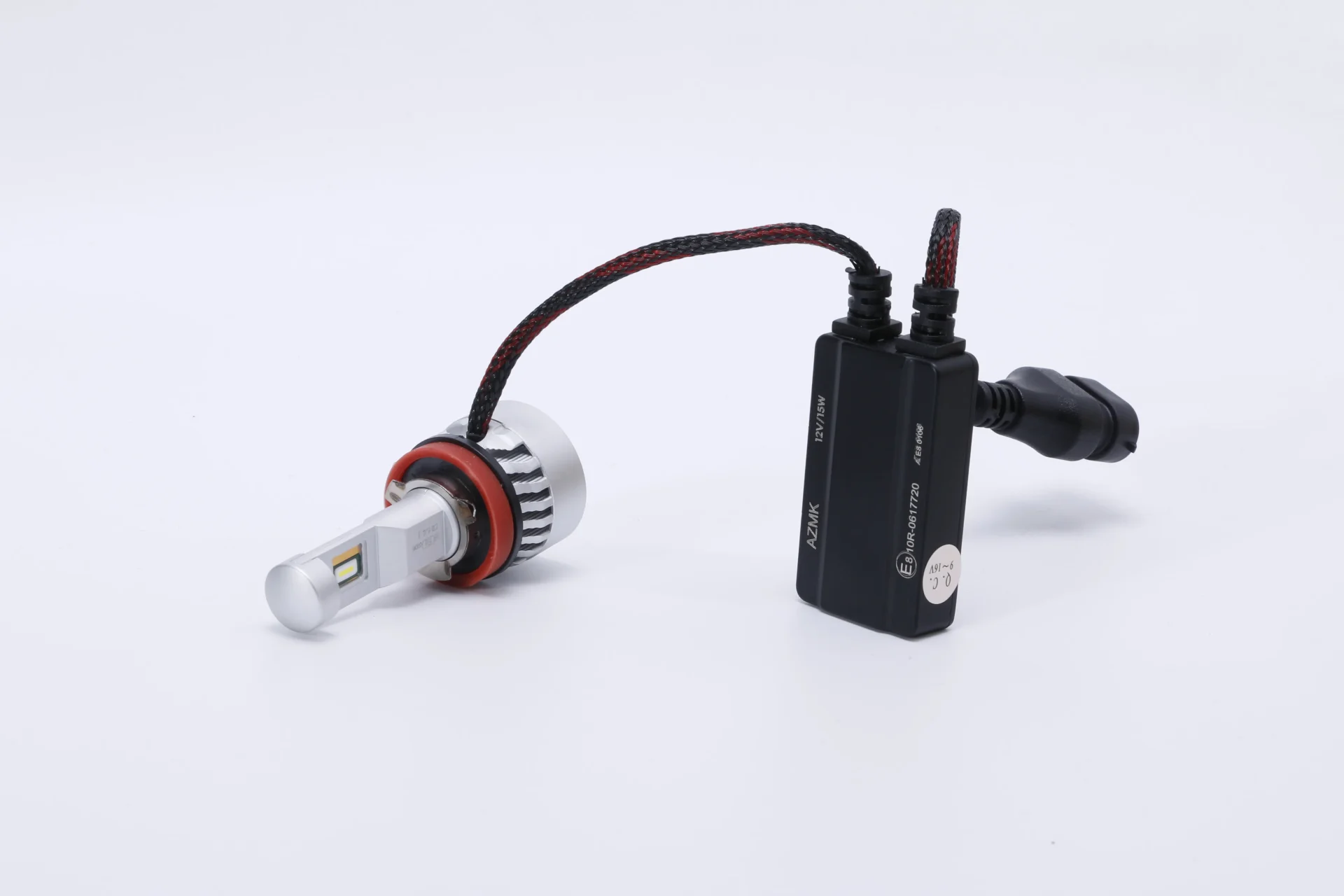
H11 LEDr optical equivalence is not a brightness match. It means an LED replacement light source reproduces what a headlamp’s optics depend on in a halogen H11: where the light comes from, how large the emitting area is, how the light is distributed, and how all of that holds as the lamp warms up. UN Regulation No. 37 builds LEDr approval around this idea. A bulb with the right lumen figure can still fail it, because the optics of an approved headlamp were designed around a filament, not around a lumen number. This article follows the equivalence from geometry to beam to heat, shows our own measurements, and ends with what a buyer should ask a supplier to prove.
What Does Optical Equivalence Mean for an H11 LEDr?
An LEDr is not any LED bulb that fits an H11 socket. UN Regulation No. 37 defines an LED replacement light source as one designed to replace a filament source of the same category designation while using a different light technology. The two share a category name and are approved as different types. The category sheet also limits where the bulb may be used: the LEDr category is “only for use in lamps approved with filament light source(s) with the same category designation.”
That limit explains why equivalence is the engineering core of the approval. The lamp was approved with a filament inside it. For that approval to carry over, the replacement has to give the optics what the filament gave them, within defined bounds. How far those bounds reach, and which markets accept the result on the road, are separate questions. UN R37 is a UNECE regulation, not an EU-only one, and approval of the light source does not settle road use, which also depends on the approved lamp and on national rules. Our H11 LEDr approval explainer covers that scope, and the LEDr compliance guide places it in the wider regulation. Ordinary retrofit bulbs sit outside this framework, as the comparison of LEDr, LED retrofit and LED substitute shows.
Why Luminous Flux Alone Is Not the Point
GRE-83-15, an informal UNECE working document from 2020 titled Equivalence Criteria, sorts the parameters of a replacement source into four groups. Some must be the same as the halogen bulb. Some need only be similar. Some are allowed to differ but stay controlled. A last group holds requirements that exist only because the source is an LED.
Luminous flux sits in the first group, together with the base interchange dimensions, the maximum envelope, the connector, the test voltage, the colour, the light centre length and the undistorted zone. Flux is matched, then, but it is not what separates one bulb from another. The parameters that shape the beam sit in the second group: the normalised intensity distribution in the far field, the size and position of the emitting area, the uniformity of the emitting area, and the contrast in the near field.
Read as a whole, the method aims at equivalent performance once the replacement sits in an already approved lamp, and not at a comparison of lumens. Because this is an informal working document, we use it to explain the logic. The binding tests and limits are in the current text of UN R37 and its category sheet, and the sections below draw on those. Why marketing lumen figures mislead buyers is covered separately in why beam pattern matters more than lumens.
Filament Geometry and Emitting Area
The PGJ19-2 base, the maximum envelope and the light centre length are held the same as for the halogen bulb, so the lamp holds an H11 LEDr in the same place as a halogen H11. What remains to be matched is the light source itself.
Halogen filament geometry
A filament is a small, compact radiator, and the lamp’s optics were designed around its position. A reflector or projector treats it as the source and sends its light to the road accordingly. An approved headlamp therefore carries an assumption that nobody prints on the lamp: the light comes from about here, from something about this size.
Halogen filament vs LED emitter: how the emitting area is rebuilt
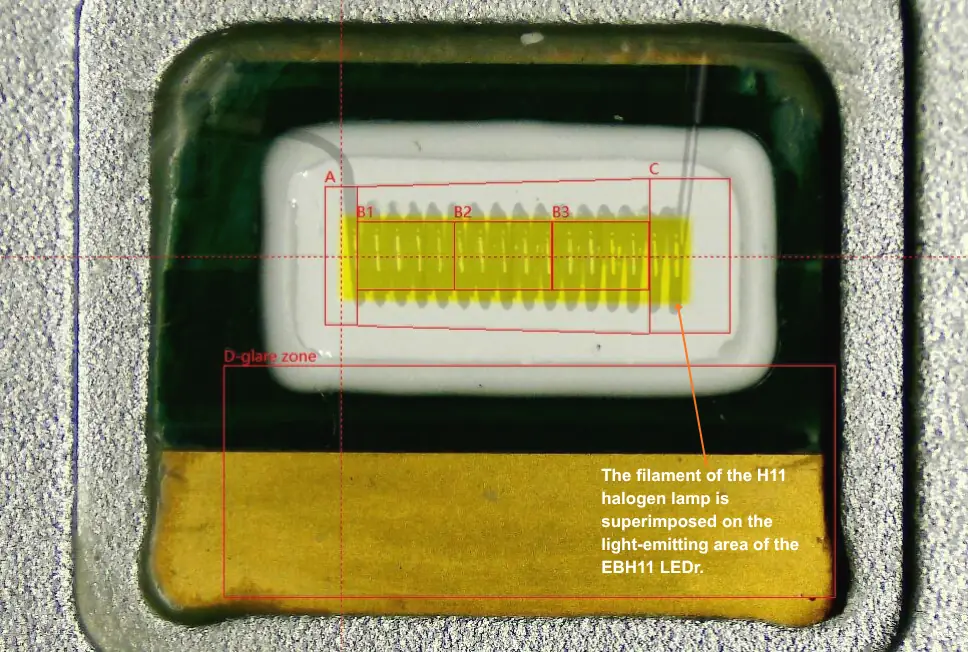
An LED replacement cannot copy a coil of tungsten. It uses chips on a carrier, and it has to reproduce the filament’s effective emitting area: its position, its size and how evenly it shines. GRE-83-15 places these in the similar group, so the replacement is not asked to be identical, only close enough that the optics still behave. The category sheet turns “close enough” into limits, with the H11 box system as the measuring frame.
The box system takes the light centre length as its origin along a reference axis. It defines a frame around the emitting area, requires a minimum share of the bulb’s flux to fall inside that frame, splits the frame into zones that each carry a permitted share, and sets uniformity and contrast requirements. Far-field intensity is measured with a standard photometer and normalised to a fixed reference flux, so two bulbs of different brightness can be compared on distribution alone.
H11 LEDr Configuration-2 also allows designs with opposing emitting surfaces. The H11 LEDr/3 category sheet limits distance z between the surfaces of the opposing light-emitting areas to 2.9 mm (official R.E.5 amendment). Configuration-2 changes the directions in which screen projection and normalised luminous intensity distribution are checked. The other basic dimensions and the electrical and photometric parameters stay as in Configuration-1.
Measured: chip/emitter thickness of one EB H11 LEDr sample. An external micrometer recorded 1.154 mm across the chip/emitter thickness shown in the photograph. This reading is not the Configuration-2 distance z between the opposing light-emitting-area surfaces and cannot be compared with the 2.9 mm category limit. A single sample measurement does not prove type approval. The published EB H11 LEDr review shows the photograph, but its current distance label must be corrected before it can support a distance-z claim.
Why position is held to a tolerance band
The optics were designed for one source position. The practical question is how far a source may sit from that position before the beam changes in ways the lamp approval never saw. That is why emitting area position and size are measured and not assumed from a datasheet, and why two bulbs with equal lumens can behave differently on the road.
How the Beam Forms in Reflector and Projector Optics
The bulb is only half of the optical system. The lamp shapes the beam, and the bulb supplies the source the lamp was designed to shape. UN R37 does not approve a bulb by checking it against the screen points of the lamp regulations such as R112 or R149. The light source category sheet checks near-field and far-field equivalence instead, and the lamp approval stays with the lamp regulation.
Reflector optics
In a reflector headlamp the reflecting surface collects light from the source and spreads it across the road. Each part of the reflector is shaped for a source at a particular location. A source that is larger or sits elsewhere sends light along paths the designer did not plan. The beam pattern widens, the hot spot moves, and light can land where it should not.
Projector optics
A projector headlamp gathers light into a focal region where a shield forms the cut-off before a lens projects the result forward. The sharpness of the cut-off depends on how closely the source matches the position and size assumed in the design. An emitting area wider than the filament softens the cut-off line, and one that is displaced moves it.
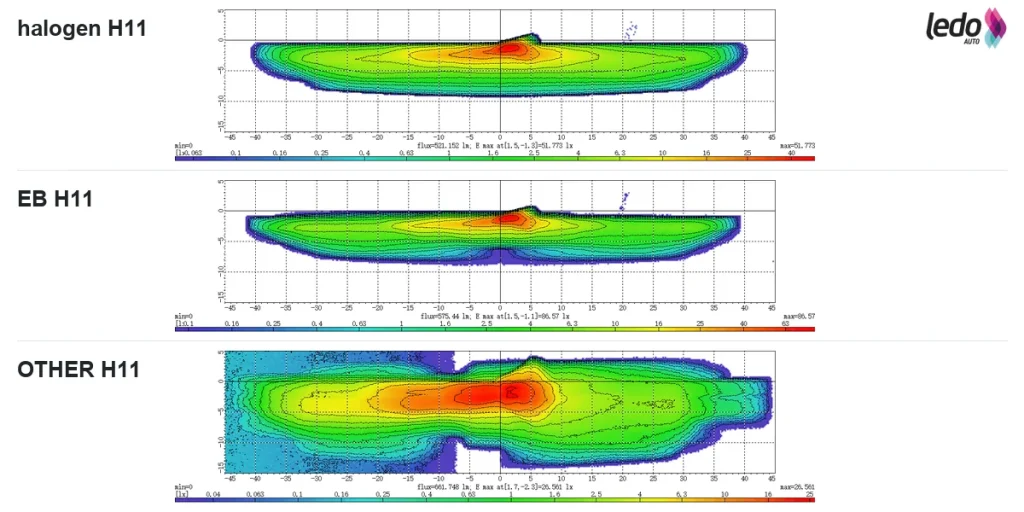
What to look for in the figure: where the cut-off sits relative to the halogen reference, how much light falls above it, and whether the hot spot moves.
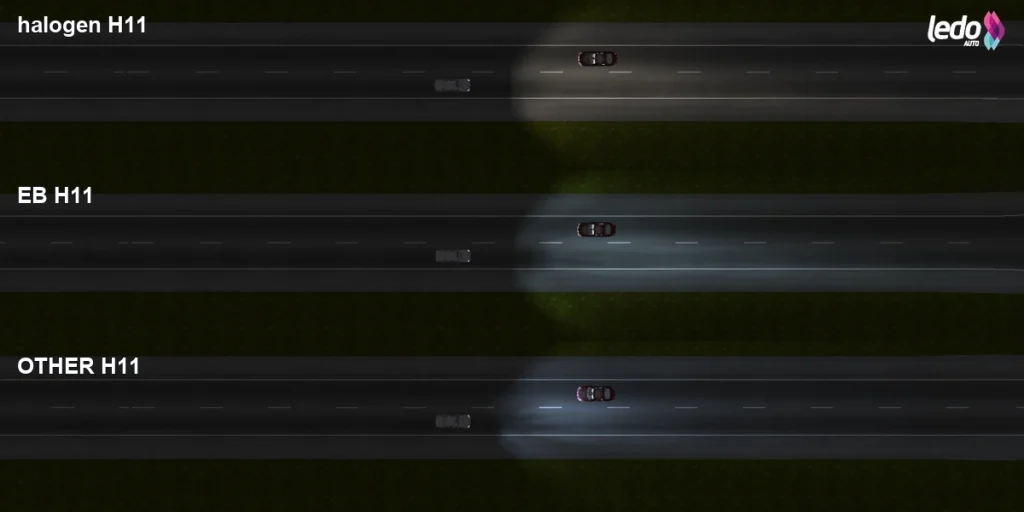
The night views are a visual aid for the simulation above .
Temperature and Lumen Maintenance: Does Heat Change the Beam?
A halogen filament is already hot when it works. An LED loses output as it heats, so a bulb that matches a halogen on a cold bench can drift once the lamp is closed and warm. Under UN R37 Annex 6 as introduced by the adopted amendment, luminous flux is measured at test voltage in still air at (23 ± 2) °C after 1 minute and after 30 minutes of operation. The 30-minute value must meet the applicable minimum and maximum limits. Unless the category sheet specifies otherwise, it must either be 80–100% of the 1-minute reading, or, if the 1-minute reading also meets the applicable limits, differ from it by no more than ±20%.
The H11 category also requires an additional test at 60 °C ambient air temperature: luminous flux at that temperature must be at least 75% of the objective luminous flux, both measured at test voltage (official R.E.5 H11 LEDr/2 category sheet). Holder temperature, current and power are recorded as well. GRE-83-15 lists the 1-minute and 30-minute thermal behaviour among the additional LED requirements.
Measured: emitting-area surface temperature of one EB H11 LEDr sample. The published EB H11 LEDr review reports a maximum reading of 67.3 degrees C, but it gives both 20 minutes and 30 minutes as the measurement time. The original test log is needed to resolve the duration and to confirm which electrical and ambient conditions apply to this thermal image. Chip junction temperature was not measured. The surface reading does not show whether the sample passes the UN R37 luminous-flux or H11 elevated-ambient tests. For purchasing, request the 30-minute flux result and the raised-temperature test result.
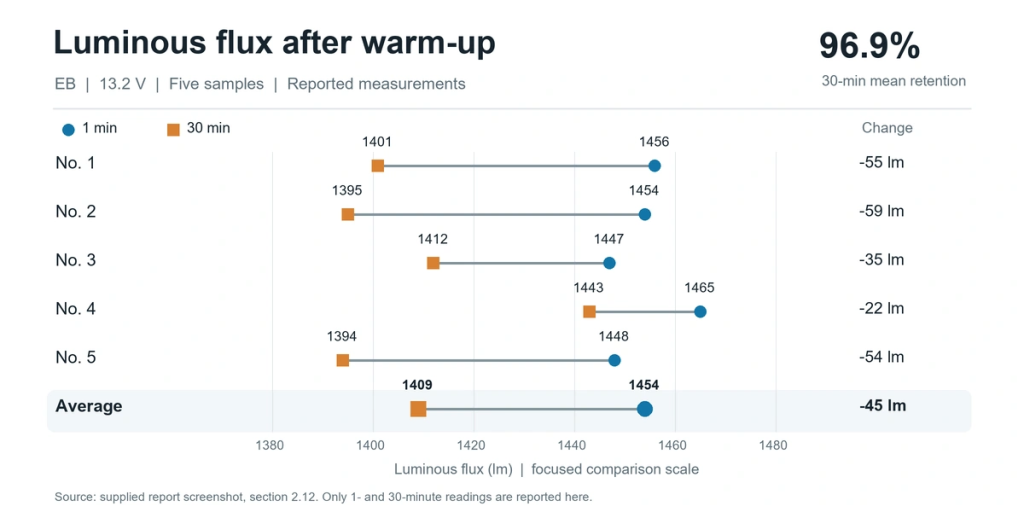
Key Evidence Summary: Which Evidence Proves What?
Each item below proves one part of the equivalence and leaves another part open.
|
Evidence |
What it shows |
What it does not show |
Status |
|---|---|---|---|
|
UN R37 and the H11 category sheet |
The binding tests and limits for H11 LEDr |
Whether a given bulb holds an approval |
Current regulation text |
|
GRE-83-15, Equivalence Criteria |
The logic of the same, similar, different and additional parameter groups |
Binding requirements |
Informal working document, 2020 |
|
Chip/emitter thickness, one EB sample |
Micrometer reading of 1.154 mm across the emitter thickness |
Configuration-2 distance z, beam pattern or approval |
Own measurement; not distance z |
|
Box system overlay on the halogen filament position |
Position and size of the emitting area against the reference |
Beam pattern in a real lamp |
Own measurement |
|
Reflector simulation with halogen, EB LEDr and ordinary LED |
The direction in which the beam changes when the source differs |
Road performance or approval |
Simulation |
|
Night-view renderings |
A visual impression of the simulation |
Measured performance |
Simulation |
|
Flux against warm-up time |
How output changes between the 1-minute and 30-minute readings |
Junction temperature |
Own measurement |
|
Nine-point illuminance and thermal image in the EB review |
Illuminance at the recorded points; 67.3 degrees C surface temperature with timing unresolved |
Compliance with any limit |
Own measurement; original thermal log needed |
What Evidence Should Buyers Request to Verify H11 LEDr Equivalence?
An equivalence claim is a request for documents. The requests below separate suppliers who measured equivalence from those who inherited a lumen figure.
- The approval certificate, with the category and type matching the bulb in your hands and the holder named. The steps are in how to verify an ECE R37 H11 LEDr certificate.
- The test report, covering emitting area position and size, normalised intensity distribution and flux at 1 and 30 minutes, with test voltage, ambient temperature and sample state stated.
- The photometric data behind the distribution, not a summary line.
- Which parameters from the same, similar and different groups the supplier measured on the sample and which they took from the type approval.
- Conformity of production records, so the sample you test represents the batch.
A mark on the bulb replaces none of this. An E-mark alone does not show road legality, and an R10 report covers electromagnetic compatibility only. The full list of supplier documents is in the H11 LEDr supplier evidence checklist. To see the same evidence applied to a product, read the EB H11 LEDr review and the H11 LEDr product page, or send a question to our engineers.
Frequently Asked Questions
By Jack Liu, Co-founder & Product Director, LEDOAUTO
Regulatory review: pending LEDOAUTO Engineering Team sign-off
Last reviewed: 2026-11-05
References
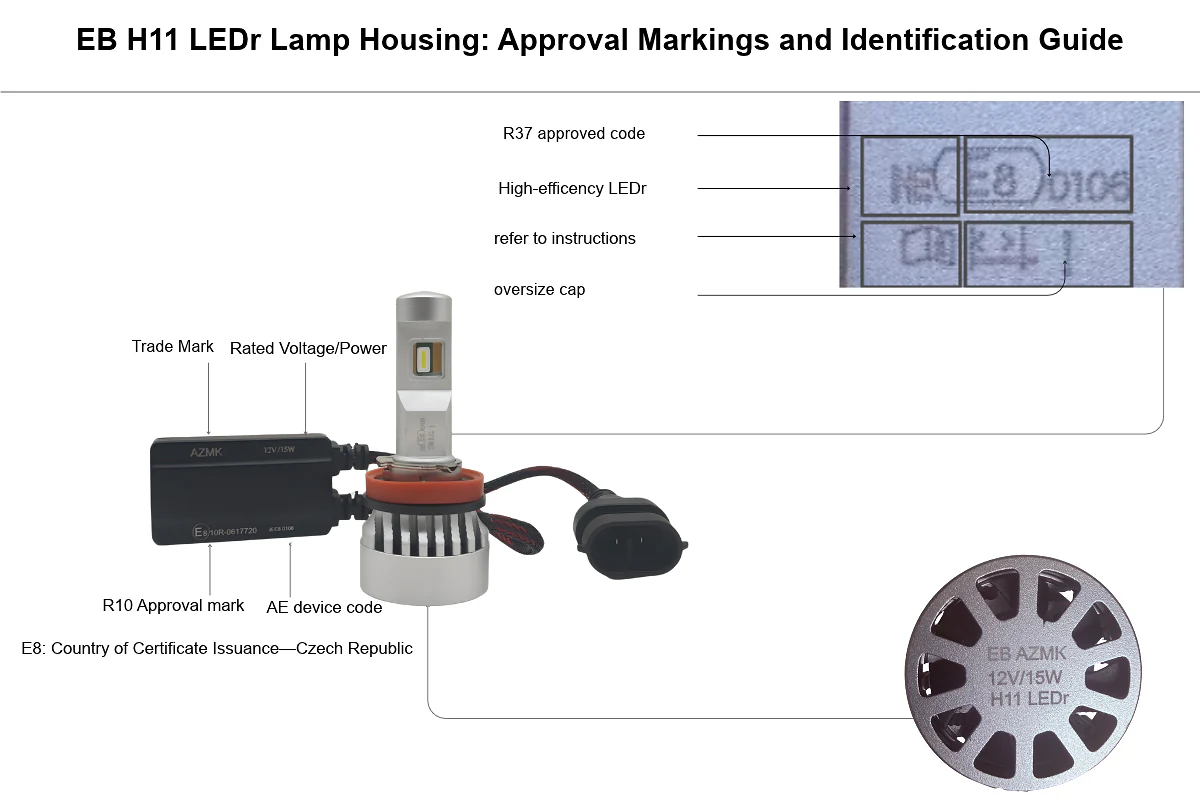
How to Read an E-mark on an LED Bulb: Four Things the Mark Does and Does Not Tell You