How to Verify an ECE R37 H11 LEDr Certificate Before Importing
To verify an ECE R37 H11 LEDr certificate, look beyond whether a PDF looks genuine. First confirm that the approval communication is an authentic, complete document. Then match its holder, approved type, H11 category and approval code to the bulb offered for production. Finally, check that the approval scope and the destination market support the road-use statement you plan to make. An E-mark photo alone cannot answer all of those questions.
Can an approval claim be checked from one document?
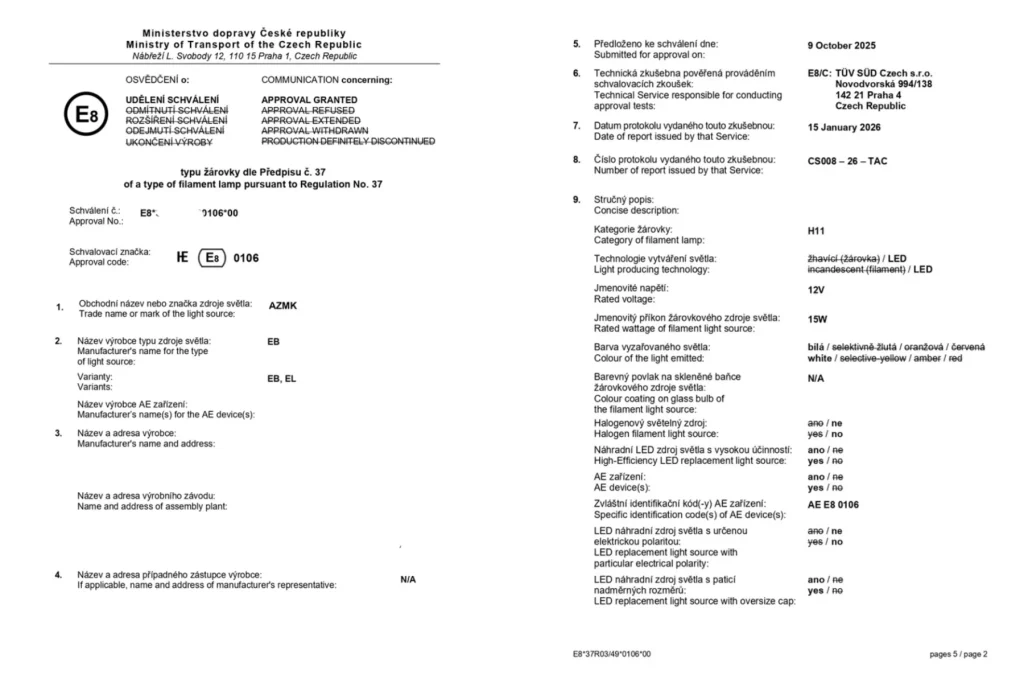
No. A credible file is only the starting point. The approval communication must identify the relevant regulation, applicant or holder, manufacturer or type information, light-source category, rated characteristics, approval code and any extensions. The product itself must carry a clear, durable marking that corresponds to that record. Supporting drawings, photographs and the report index should describe the same type.
UN Regulation No. 37, Revision 7, Amendment 11 is the current consolidated official text used for this review. It separates the application and approval record from the marking placed on the light source. That distinction matters when a supplier sends a certificate for one type but offers a different bulb, electronics package or brand configuration.
An E followed by a country number identifies the Contracting Party whose authority granted the approval. It does not identify the product’s country of origin. It also does not, by itself, identify UN R37, prove that the offered bulb is the approved type or settle road use in every market.
How do you verify the certificate step by step?
1. Request the complete approval communication
Check whether the document records an approval, an extension, a refusal, a withdrawal or production discontinuation. A file that once recorded an approval is not proof that every later version remains within scope. Ask the supplier to identify which communication and extension cover the production version being quoted.
Ask for the full approval communication, including continuation pages, annexes, extension records and the identification drawing or photographs referenced by the document. A cropped cover page removes the fields needed to connect the approval to a product. If commercial details must be redacted, the supplier should leave the regulation, holder, approved type, H11 LEDr category, approval code, status and enough identifying information visible for a meaningful review.
2. Check the holder, manufacturer and supplier relationship
For private-label supply, do not treat an existing certificate as something a distributor can borrow. A trademark-only route can apply when the same manufacturer makes a fully identical type and follows the recognized approval procedure.
Write down the legal name and address shown on the approval communication. Compare them with the manufacturer declaration, quotation, invoice identity and the factory named in the document pack. The company selling the bulb does not have to be the certificate holder, but the relationship must be explained with evidence.
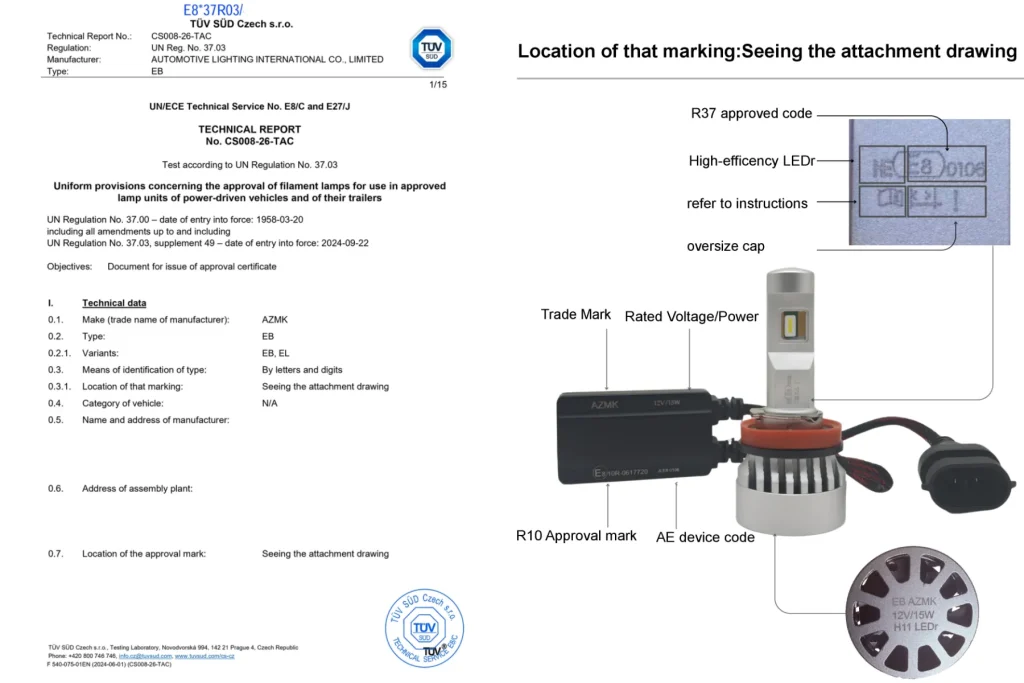
3. Match the approval code to the bulb marking
Request sharp photographs of the exact sample and production marking, not an artwork rendering. Compare the E-mark and adjacent approval code with the approval communication. Also check the applicant’s trade name or mark, rated voltage, H11 category designation and the required LEDr identification. The marking should be legible and durable on the light source or cap as required, while packaging carries its own information.
A packaging logo or E-mark is not a substitute for the light-source marking. Check the physical bulb before sample approval and again during pre-shipment inspection. If the photo is too blurred to read or the supplier will not show the marked product, keep the approval claim open rather than inferring a match.

4. Confirm the category and approved type match the offer
The quoted product must be H11 LEDr, not simply an LED bulb with an H11-style connector. Compare its base, category name, rated values, light-source technology, drawings and model identity with the approval communication. PGJ19-2 can help identify the H11 interface, but physical fit is not a substitute for type approval.
Pay attention to changes in electronics, emitter geometry, thermal parts, rated values or housing dimensions. A shared model name does not prove that every version belongs to the same approved type.
ECE R37 is part of the UNECE framework, not an EU-only regulation. Confirming that a category exists in the UNECE framework is not the same as confirming the offered product. An approved category does not make every H11 LED bulb approved, and a national H4 or H7 vehicle-list acceptance is not UN R37 category approval. Where an approved-category question matters for a specific product, treat it as a separate check against the current category record rather than a claim carried by this certificate.

5. Review the report index and Conformity of Production evidence
Ask for a report index that connects test records to the approved type. The useful check is identity: report number, sample or type designation, test date, applicable category and the issuing laboratory or technical service should agree with the approval pack. Do not use an unrelated photometric report to fill a gap in the certificate chain.
Conformity of Production, often shortened to CoP, addresses whether production continues to conform to the approved type. Ask for a controlled summary of the supplier’s applicable checks, revision records and handling of nonconforming output. UN R37 does not set one universal monthly or per-batch testing frequency for every business, and it does not create one importer retention period for every destination. The approval conditions, the manufacturer’s control plan and market rules must supply those details.
Which documents and evidence should you check?
Use this list before approving a sample, packaging artwork or purchase order. Record the filename, revision and review result so a later extension or model change does not get mixed into the original decision.
|
Evidence |
Minimum check |
Warning sign |
|---|---|---|
|
Approval communication |
Regulation, holder, approved type, H11 LEDr category, approval code and status |
Cropped first page or missing annexes |
|
Extension history |
Latest communication covers the offered production version |
Supplier cannot identify the applicable extension |
|
Identification drawing or photographs |
Shape, base, marking locations and type agree with the product |
Generic illustration unrelated to the sample |
|
Bulb marking photos |
E-mark, approval code, H11, LEDr, trade mark and rated voltage are readable |
Packaging mark shown instead of the bulb |
|
Manufacturer relationship evidence |
Seller, factory, holder and brand relationship is documented |
Different legal names with no explanation |
|
Test-report index |
Reports identify the same approved type and category |
Reports use another model or omit sample identity |
|
CoP summary |
Current control plan, revision control and nonconformance route exist |
A one-time test is presented as ongoing control |
|
Target-market review |
Approval conditions and local implementation have been checked |
“E-marked” is used as an unrestricted legality claim |
The 1958 Agreement, Revision 3 provides the international type-approval framework. The country identifier points to the authority that granted an approval under that framework. It is not an origin label. There is also no single UNECE public database that lets a buyer validate every approval number issued by every Contracting Party. When the paperwork remains unclear, contact the named approval authority or request confirmation through a qualified regulatory reviewer.
For the full document set, use the downloadable H11 LEDr supplier evidence checklist, which lists every file a supplier should provide before a bulk order. Also see the LEDr, retrofit and substitute comparison and the H11 LEDr product page.
What mistakes do buyers make most often?
Treating any E-mark as proof of road legality
The country code only identifies the approving authority. The complete mark, regulation, approved type, category, installation conditions and destination-market rules still need checking. A genuine E-mark under another regulation does not prove H11 LEDr approval under UN R37.
Checking the box but not the bulb
Packaging information is useful for traceability, but it does not replace the required marking on the light source. Inspect readable photographs and a physical sample. Repeat the match during production inspection if artwork, brand or supplier details change.
Using UN R10 as a substitute for UN R37
UN R10 addresses electromagnetic compatibility within its scope. It does not establish the H11 LEDr category, light-source geometry, photometric requirements or road-use approval under UN R37. Keep the R10 record as separate evidence.
Reusing a real certificate for a different type
Certificate misuse can involve an authentic document attached to a bulb with a different type, marking, category, rated value or construction. Compare identifiers across the communication, drawings, report index, sample and production photographs. A polished PDF does not repair a product mismatch.
Assuming the supplier must be the certificate holder
A distributor or trading company may lawfully sell an approved product without appearing as the holder. The missing name is not automatic proof of fraud. It is a prompt to document the chain between holder, manufacturer, supplier and offered brand. Keep the claim unresolved if that chain cannot be shown.
What should you do when the evidence does not match?
Do not approve packaging or release the purchase order while the document-to-product link is unresolved. Send the complete certificate, extension pages, product photos and report index to LEDOAUTO for a document review. The review can identify missing fields and mismatches, but final confirmation may still require the issuing approval authority or a market-specific legal review.
Use the downloadable checklist during supplier screening, then request the current H11 product evidence pack. The live page must not describe this review as free until the commercial owner confirms that offer and the submission form is connected.
Frequently asked questions
Author: Jack Liu, Co-founder & Product Director, LEDOAUTO
Regulatory review: LEDOAUTO Engineering Team, verified against official UNECE documents
Last reviewed: 22 July 2026