
A supplier offering ECE R37 H11 LEDr for wholesale or private label should be able to hand over eight groups of H11 LEDr supplier evidence before you commit to a bulk order: the approval certificate, proof of certificate holder identity, conformity of production records, optical and thermal test reports, R10 EMC coverage, correct product and packaging markings, batch traceability records, and written warranty terms. Treat these as a pass/hold screen. If a supplier cannot produce one group, put the order on hold regardless of the quoted price. A logo, an E-mark photo or a single lumen figure does not establish that the product in your quotation is the approved type.
|
Category |
Status |
Effective date |
Source |
|---|---|---|---|
|
H11 LEDr |
Approved category under UN Regulation No. 37 |
— |
Category status above was verified against official UNECE documents on 15 July 2026.
Two things sit outside that row and should not be read into it. National positive lists or vehicle lists that permit certain H4 or H7 LED products in individual countries are a separate national mechanism, not a UN R37 LEDr category approval, and a document issued under such a scheme does not make a product an approved LEDr type. Other categories are at different stages of the UN R37 process; the current picture for all of them is maintained in our complete ECE R37 LEDr guide rather than repeated here.
This guide is written for importers, wholesalers and private-label buyers sourcing an H11 halogen replacement with a PGJ19-2 interface. It keeps type approval, physical fitment and road-use decisions in separate columns, because most sourcing mistakes happen where a supplier merges them.
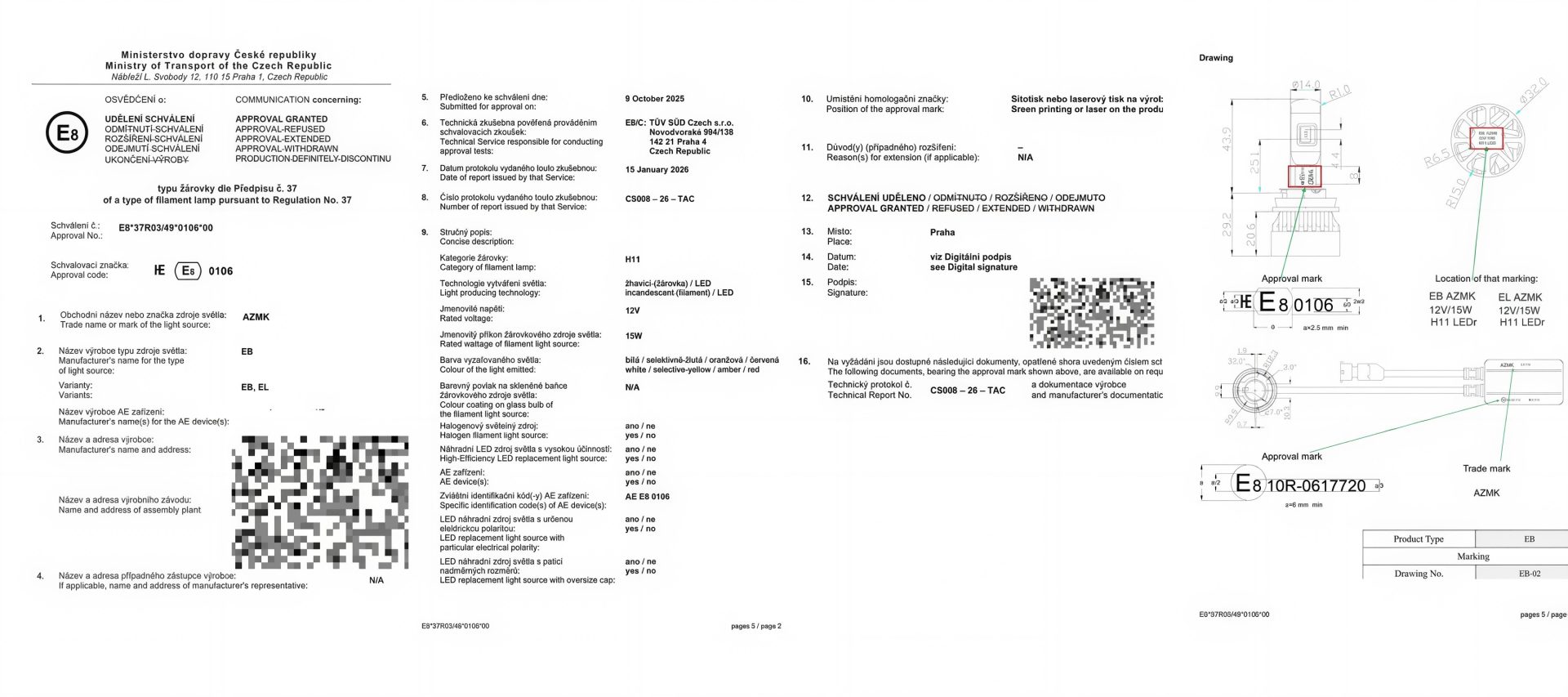
Is the approval certificate genuine and complete?
The approval of a light source type is documented in a formal communication issued by an approval authority, with defined fields covering the holder, the type, the category and the approval code. A supplier claiming “certified H11 LED” without that document has, in regulatory terms, claimed nothing.
Ask for the complete communication and its document index, not a cropped first page. Confirm that the regulation, approval authority, approval code, category, approved type and document revision are all readable and consistent. Check that the category reads H11 LEDr, that the code on paper matches the code on the sample in your hand, and that the approval drawings correspond to the product being quoted. Redaction of an address or part of a reference number is normal; redaction of the fields you need for a product match is not. Ask the supplier to explain each redaction rather than accepting a page that cannot be audited.
Does the certificate holder match the company quoting you?
The approval belongs to a specific holder for a specific type. The trademark, the type designation and the manufacturer named in the approval documents must line up with the company and the product in front of you. A sales name, a trading company or a long-standing commercial relationship does not transfer an approval.
This matters most in private label projects. A certificate cannot simply be borrowed by a distributor or relabelled onto another brand; any change in trademark or type has to go through the procedures foreseen in the approval framework. When a supplier says “we can put your logo on it, same certificate,” ask them to show in writing how the approval documents will reflect that arrangement, and submit the proposed mark and artwork before production rather than after. Any change to the type, electronics, emitter geometry or rating needs its own approval assessment. A supplier who has done legitimate OEM work will answer in specifics; our note on private label scope on the EB product page shows what that answer should look like.
How does the supplier maintain conformity of production?
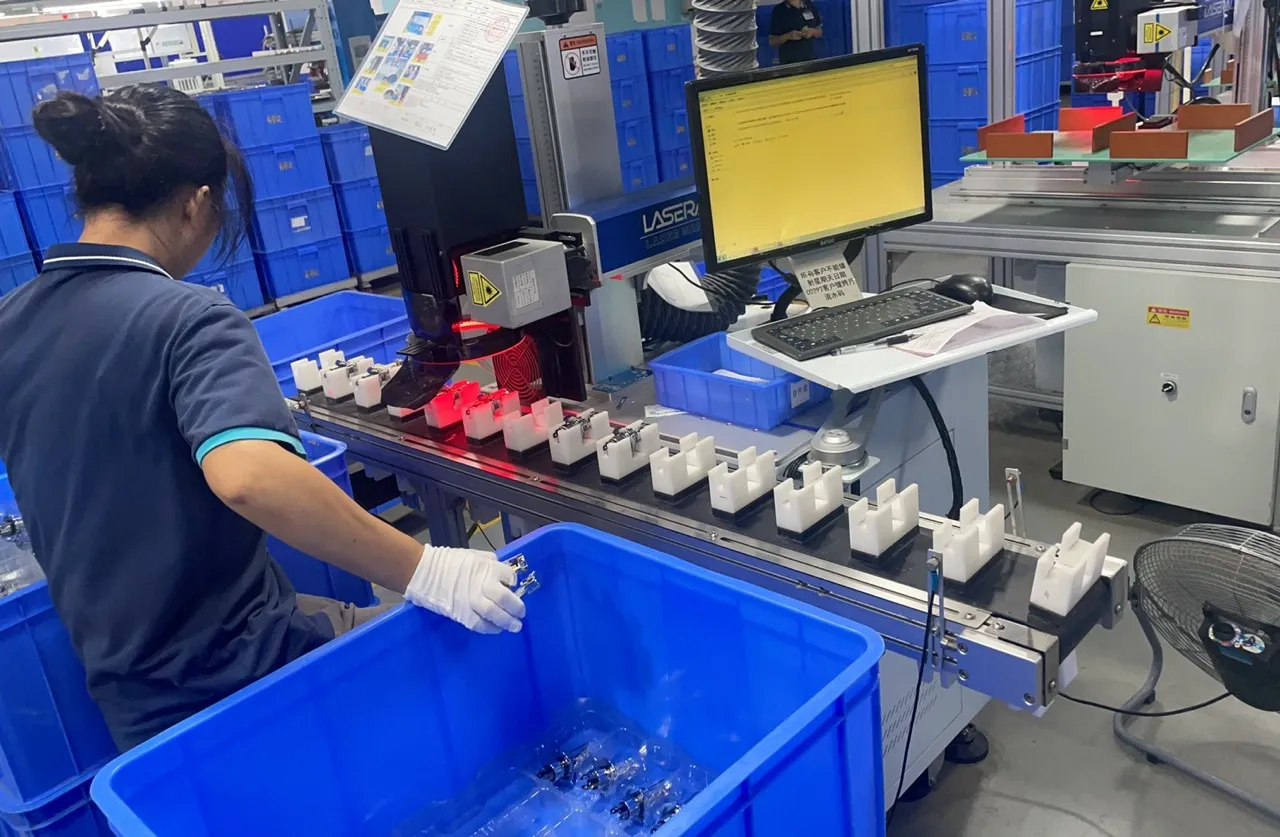
Type approval covers the tested type. Conformity of production, usually shortened to CoP, is the control system that keeps unit number 40,000 identical to the samples that passed. Before granting approval, the authority verifies that the manufacturer has effective arrangements to control production conformity; after approval, the manufacturer must keep the product compliant with the marking and technical requirements, run the prescribed CoP tests and keep records. Approval can be withdrawn if production stops conforming.
So ask for a redacted CoP plan, the inspection and test stages that apply to the offered model, the latest record index, and the documented procedure for handling nonconforming units. Verify that those records carry the same type identity as the approval pack. A factory that runs real CoP can show sampling records and a nonconformity procedure within a day. A factory that cannot is selling you the certificate rather than the production behind it.
What should the optical and thermal test reports contain?
An H11 LEDr claim rests on more than colour temperature or a headline lumen number. The applicable test programme covers photometric, geometric, colour, electrical and thermal conditions for the category and type. Expect the report set to address: aging before measurement, luminous flux inside the box system zones, normalized luminous intensity distribution, chromaticity and UV-related checks, emitter position geometry, readings taken at one minute and at 30 minutes of operation, behaviour at elevated ambient temperature, performance across the low and high test voltages, current and power consumption, PWM operation where relevant, and cap temperature.
You do not need a laboratory to use this list. Its purpose is to compare what a supplier sends against what the programme actually requires, and to check that the report names a sample identity you can trace back to the approval communication and forward to the production marking. A one-page “lumen test” with no sample code and no test conditions is not an R37 report. Order samples in the proposed production specification and record the sample code, package code and test conditions; a bench or vehicle check can reveal installation and electrical problems, but it does not widen the approval scope. For how these measurements connect to beam behaviour in a real headlamp, see our complete ECE R37 LEDr guide.
Does the R10 certificate cover this exact model?
LED light sources contain electronics, so electromagnetic compatibility under UN Regulation No. 10 comes into play, and the supplier may hold R10 documentation for the relevant electronic subassembly. That evidence has one job and one job only. An R10 certificate proves EMC compliance; it is not an R37 approval, it says nothing about optical performance, and it does not establish road use.
Compare the model, variant and hardware identity in the R10 evidence against the H11 LEDr being quoted. Establish whether the electronic control is integrated or supplied separately, and identify which configuration was actually tested. If the report covers a product family, ask for the rule that connects your variant to that family. Keep R10 in its own folder and its own column in your supplier matrix, and reject any matrix that merges R10 and R37 behind a single tick labelled “E-mark certified” — that merge is the single most common way an ordinary retrofit gets sold as an approved light source. The difference is set out in our LEDr vs retrofit comparison.
What must be marked on the bulb and printed on the packaging?
The documents and the physical goods need a visible identity chain. Markings on the light source body include the approval code; the packaging carries its own mandatory content: the trademark, the rated voltage, the category designation together with LEDr, and the approval code. Where an approval carries restricted-application conditions, the packaging must additionally carry the required symbol, instructions and a reference to the applicable vehicle list, plus the relevant safety warnings.
Request clear photos of the production-intent bulb, base, control unit where applicable, unit label, inner box and shipping carton, and compare each against the approval pack. The H11 interface should match PGJ19-2, but physical fit is a fitment fact, not a road-use conclusion. A correct certificate attached to goods carrying a different marking is a mismatch serious enough to hold the order, not a printing detail. For OEM packaging, freeze the artwork only after the trademark and approval-holder route has been confirmed in writing.
Can the supplier trace a batch after delivery?
Here the honest answer is narrower than most marketing suggests. UN R37 requires CoP testing and record-keeping, but it does not fix a universal set of traceability fields or a retention period valid for every company. Those come from the manufacturer’s own CoP plan and from the rules of your target market.
That makes the question sharper rather than weaker. Ask the supplier to demonstrate the path from a finished-unit code back to production date, controlled bill of materials, inspection record and shipment, and test one real sample code against their system during qualification. Then write the fields you need and the retention term you need into the quality agreement. When a field failure, a glare complaint or a document query lands on your desk two years after import, the supplier’s batch records are what stand between you and an unanswerable letter.
What warranty and RMA terms should be settled before ordering?
The final group is commercial rather than regulatory, and it belongs in writing before the order rather than after the first failure. Technical evidence reduces approval and quality risk; it does not decide what happens when units fail, arrive with the wrong marking, or differ from the accepted sample.
Settle the warranty period and start date, excluded conditions, sample retention, claim evidence and response time, replacement or credit method, and freight allocation by scenario. Add a specific remedy for product-to-document mismatch and for unapproved material or design changes, and name who can authorise an RMA and how affected batches get contained. A supplier confident in their CoP will also share failure analysis data, because their records make it cheap to produce. MOQ, sample price and lead time belong in the commercial review, and none of them is a reason to waive an unresolved approval check.
Get the checklist, then put it to work
Use the eight evidence groups above as a pass/hold screen before releasing a bulk order.
We hold ourselves to the same screen. Product details, OEM scope, sample terms and the documents we make available for review are on the EB product page.
Frequently asked questions
Sources: UN Regulation No. 37, Revision 7 – Amendment 11, current consolidated text (unece.org) · Agreement of 1958, Revision 3, framework document (unece.org) · Consolidated Resolution on the Construction of Vehicles (R.E.3), Revision 7 (unece.org)
Author: Jack Liu — Co-founder & Product Director, LEDOAUTO
Regulatory review: LEDOAUTO Engineering Team — verified against official UNECE documents
Last reviewed: 15 July 2026
References
How to Source Road-Legal H11 LED Bulbs from China

ECE R37 Certified H11 LEDr Bulb Manufacturer for OEM and Wholesale
