Buyers checking H7 LEDr legal status in Europe get the short answer first: H7 is not a generally approved UN R37 LED replacement category. As of 22 July 2026, the reviewed UNECE documents show no in-force H7_LEDr category sheet in Resolution R.E.5, and no H7 category text has entered formal adoption. Some H7 LED products hold national approvals for named vehicles, but those positive-list approvals are narrower than a UN R37 light-source approval and must not be relabelled as one.
Last reviewed: 22 July 2026. Review trigger: a new H7 category proposal, GRE adoption, WP.29 adoption or an updated R.E.5 category sheet.
What is the current H7 LEDr approval status?
UN Regulation No. 37 provides the approval framework for filament light sources and established LED replacement categories, whose sheets sit in Group 5 of Resolution R.E.5. The current UN R37 consolidated text and the UNECE category-development records reviewed for this page do not contain an in-force H7_LEDr sheet.
GRE-94-18 (informal, 2026) and Article 50 of Regulation (EU) 2018/858 describe H4 and H7 as still under investigation at UN level. Working-level documents within the UNECE WP.29/GRE framework, reviewed by the LEDOAUTO Engineering Team on 22 July 2026, show continued development of other LEDr categories but no H7 proposal in the formal process. This signals development activity, not a ban and not an approval.
|
Category |
Status |
Effective date |
Source |
|---|---|---|---|
|
H7 |
Under investigation at UN level; no in-force UN R37 H7 LEDr category sheet in reviewed UNECE documents; national positive-list approvals may cover specific products and vehicles |
No UN effective date |
UNECE WP.29/GRE document review, 22 July 2026 |
|
H4 |
Under investigation at UN level; no in-force UN R37 H4_LEDr category sheet in reviewed UNECE documents; national positive-list approvals may cover specific products and vehicles |
No UN effective date |
UNECE WP.29/GRE document review, 22 July 2026 |
|
H11 |
Established UN R37 LEDr category route in R.E.5 Group 5; an individual product still needs a matching approval and must stay within its conditions |
In force; check the applicable R.E.5 sheet and approval document |
UN R37 consolidated text and GRE-83-16 H11 equivalence report |
UN R37 (ECE R37) belongs to the UNECE framework, not solely to the European Union; 1958 Agreement parties include the United Kingdom, Norway, Switzerland, Turkey, Japan and Australia. Approval and road use remain subject to the approval scope, lamp, installation and destination-market rules.
Why do buyers keep finding H7 LED bulbs for sale?
Product availability does not prove a particular approval route. H7 is widely used in the vehicle fleet, so suppliers offer off-road products, unapproved retrofit bulbs and products approved nationally for selected vehicles.
Germany and France have issued national approvals through vehicle positive lists, and some other countries use related processes. These approvals rely on lamp beam measurements and vehicle installation testing; the list defines where each product may be used.
This route is not the same as creating an H7_LEDr category sheet in R.E.5 and granting a product approval under UN R37. The distinction matters on listings and packaging. “Approved for selected H7 applications” may be supportable when the national document and the current vehicle list match. “UN R37 H7 LEDr” is not supportable without an in-force category and a matching product-specific R37 approval.
What makes an H7 LED replacement difficult to standardize?
An H7 halogen source gives the lamp optics a defined filament position and emission geometry. A replacement must place its light-emitting area close enough to that reference for the lamp to form the intended beam. Socket fit alone cannot prove this.
The UNECE equivalence criteria in GRE-83-15 compare the LED replacement against its filament counterpart on photometric, geometric, electrical and thermal parameters, including the size and position of the light-emitting area. Packaging works against that goal: emitters, driver electronics and a thermal path must fit the same compact envelope, and every millimetre added for heat can move the emitting area off the reference position.
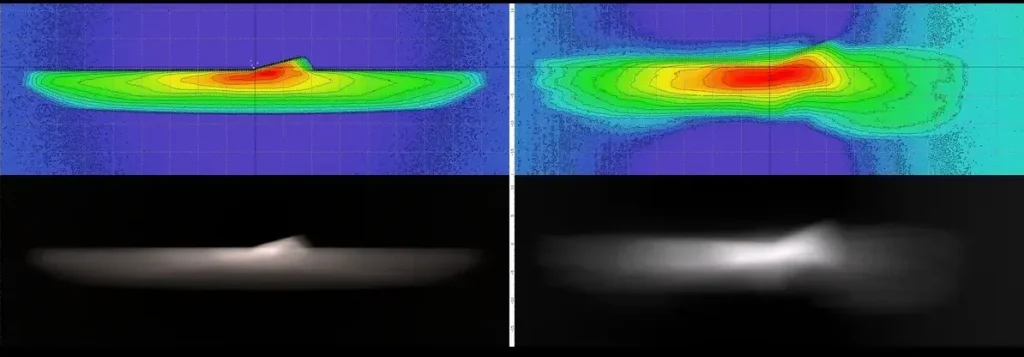
Optical performance also depends on the source and lamp as a combination. The UNECE study GRE-84-02 tested LED replacements in different lamps and found widely varying glare and illumination results, so a clean cutoff in one lamp cannot establish equivalence across H7 applications or replace the approval process. These constraints explain why selected applications can pass national positive-list testing while a broadly interchangeable H7 category remains under investigation.
Light Pattern of the H7 LED Halogen Bulb in an H7 Reflector Headlight
Light Pattern of a Standard H7 LED in an H7 Reflector Headlight
What is allowed, and what has not been proven?
A nationally approved H7 LED product may be used only within the conditions of that approval. Obtain the approval document from the holder or responsible authority and check the current positive list: a cropped certificate, an old screenshot or a claim that “Germany approved H7 LEDs” cannot establish that the exact sample is covered.
An E-mark must be read with its regulation number, approval code and matching document. The country identifier after the E shows neither where the product was made nor H7 road use; it may refer to a different regulation entirely.
UN Regulation No. 10 addresses electromagnetic compatibility. R10 evidence is relevant to an electronic light source, but it does not replace the optical, geometric, thermal and category requirements of R37. GRE-94-18 and Article 50 of Regulation (EU) 2018/858 treat an R10-only or otherwise incorrect regulation mark presented as road approval as a non-compliance case. No stand-alone R10 conclusion can prove that an H7 bulb is a UN R37 LEDr or that it is road-legal in a particular vehicle.
CE and RoHS documents answer different questions, and neither establishes an H7 light-source approval. The same applies to lumen claims, beam photos and “fits all H7 housings” statements: each may describe a feature or a test, but none supplies the missing approval scope.
Which H7 LED claims should buyers challenge?
Treat “H7 LED bulb road legal” as incomplete until the supplier identifies the approval route, the issuing authority and the exact product type.These claims need evidence before they appear in a catalogue or listing:
- “E-marked H7 LED” without the regulation number, approval code and matching certificate
- “R10 approved, therefore road-legal” when only EMC has been documented
- “Legal throughout Europe” without country, vehicle and installation conditions
- “Direct replacement for every H7” when adapters or a vehicle list are required
- “Same beam as halogen” based only on an untraceable wall photo
Importers should compare the sample marking with the approval holder, product type and packaging identity. If the supplier cannot provide a complete document or the vehicle list excludes the intended application, keep the road-use claim out of the offer.
Why is H11 the practical UN R37 route today?
H11 has an established UN R37 LEDr category, while H7 remains under investigation. The exact H11 product still needs a matching R37 approval, correct marking and use within the approval conditions.
Review the H11, H7 and H4 category comparison before choosing a product program. Then use the H11 LEDr certificate verification guide to match the holder, category, type and approval code. Buyers ready to evaluate a current product can read the H11 LEDr approval explanation and request documents for the exact sample through the ECE R37 H11 LEDr product page.
How can buyers track an H7 status change?
A working-level paper shows technical work; a formal GRE proposal shows text entering the regulatory process. GRE and WP.29 adoption must still produce an effective R.E.5 category sheet before this page can describe H7 as in force.
Buyers can subscribe to H7 and H4 LEDr regulatory updates. Each update identifies the document number, status and effective date rather than treating a draft as approval. Until those steps occur, use the national positive-list route within its documented scope, or move an approval-led program to an established category such as H11.
Written by Jack Liu – Co-founder & Product Director, LEDOAUTO
Regulatory review: LEDOAUTO Engineering Team – verified against official UNECE documents.
Last reviewed: 22 July 2026.