The H11 vs H7 vs H4 LEDr question is not a choice between three equally approved products. As of 15 July 2026, H11 is an established UN R37 LED replacement light source category, and a March 2026 amendment added H8, H16 and HB4. H7 and H4 are not established categories. They sit on the working agenda as under investigation, and some countries cover selected H7 and H4 products through vehicle positive lists, which is a separate mechanism with a narrower scope. This page sets out the verified status of each category, the engineering reason H11 came first, and how to read a supplier who offers an “H7 LED, road legal.”
Which LEDr categories are approved right now?
An LEDr is an LED replacement light source approved under UN Regulation No. 37 for an established category in the UNECE R.E.5 system. Socket fit or an E-mark alone does not make a bulb an LEDr. The consolidated Regulation No. 37 text carries the framework; ECE/TRANS/WP.29/2024/156 brought H11 Configuration 2 into R.E.5; and ECE/TRANS/WP.29/2026/41 added three categories in March 2026.
| Category | UN R37 LEDr status | Effective date | Source |
|---|---|---|---|
| H11 | Established LEDr category; Configuration 2 included | 13 Nov 2024 (Configuration 2) | WP.29/2024/156, in current R.E.5 |
| H8, H16, HB4 | Added to R.E.5 Group 5 by Amendment 12 | 11 Mar 2026 | WP.29/2026/41 |
| C5W | Established LEDr category | In current R.E.5 | R.E.5 Group 5 |
| H7 | No established UN R37 LEDr category sheet; under investigation | No UN effective date | GRE-94-18 (informal, 2026), verified 15 Jul 2026 |
| H4 | No established UN R37 LEDr category sheet; under investigation | No UN effective date | GRE-94-18 (informal, 2026), verified 15 Jul 2026 |
Two further groups sit outside that list. H10 exists as an informal draft category sheet (GRE-94-19), and H9, HB3 and HIR2 are grouped as later high-beam development in the same working record. Neither group is an approved category. UN R37 operates under the UNECE 1958 Agreement rather than as an EU-only regulation, and its contracting parties include the EU member states alongside the United Kingdom, Norway, Switzerland, Turkey, Japan and Australia, among others. Road use still depends on the approval scope, the corresponding lamp, the installation and the destination-market rules.
How do H11, H7 and H4 compare for buyers?
| Comparison point | H11 LEDr | H7 LED product | H4 LED product |
|---|---|---|---|
| UN R37 LEDr status | Category established | No established category sheet as of 15 Jul 2026 | No established category sheet as of 15 Jul 2026 |
| Category sheet | H11 LEDr sheets in R.E.5 Group 5 | None established | None established |
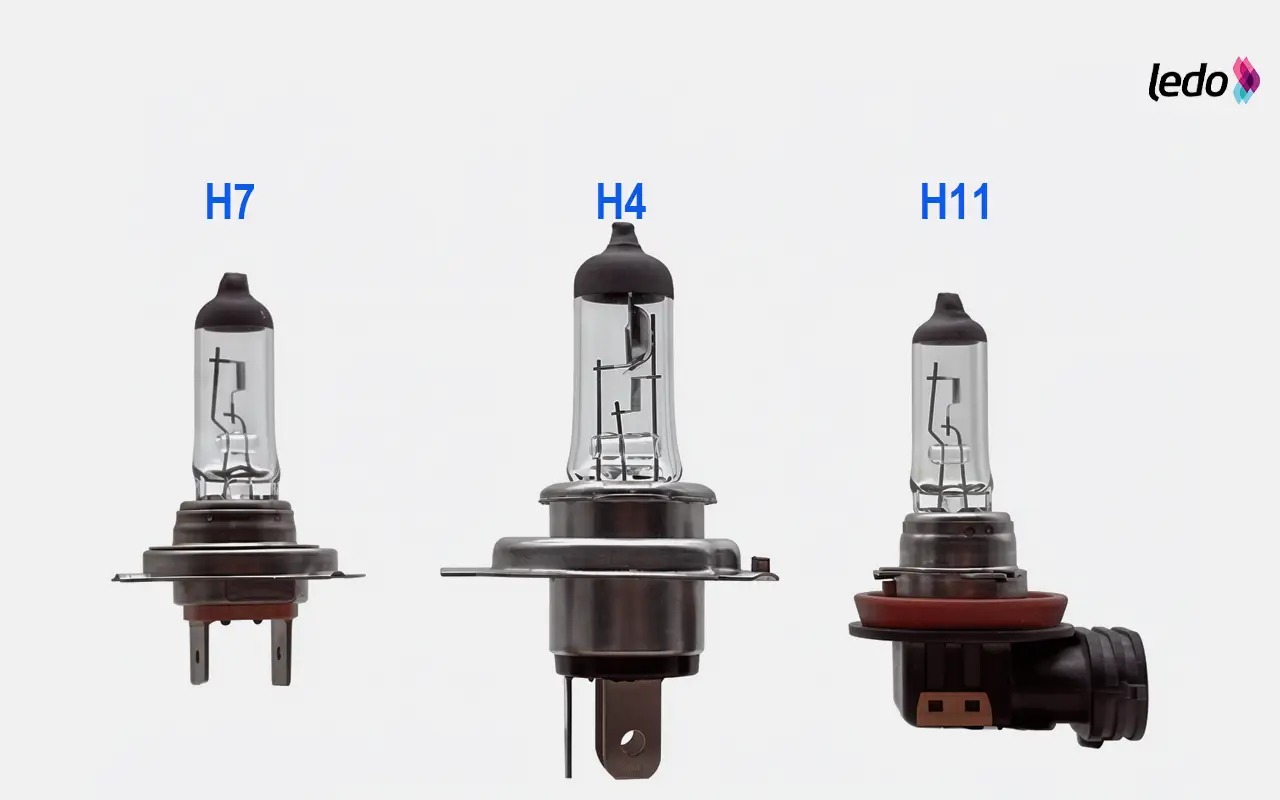
| Main design problem | Reproduce one standardized emitting region inside the H11 package | Fit emitter, driver electronics and thermal path into a compact cap while holding the filament reference geometry | Reproduce two filament functions, their relative positions and the shield effect that forms the dipped beam |
| Current market route | Product-specific UN R37 approval | National positive-list approval where accepted, or an unapproved retrofit | National positive-list approval where accepted, or an unapproved retrofit |
| Buyer position | Suitable for an approval-led sourcing programme after document verification | Do not market as UN R37 H7 LEDr; verify each national approval and its vehicle list | Do not market as UN R37 H4 LEDr; verify each national approval and its vehicle list |
The approval document, category, type, market and usage conditions all have to support whatever the product page and packaging claim. “LEDr,” “road legal” and “E-marked” are not interchangeable labels.
Why did H11 become the first LEDr category?
The official documents give no single stated reason for the sequence, but the engineering comparison shows why H11 is a narrower standardisation problem. H11 is a single-function category with a defined cap and one filament reference region, seated on a PGJ19-2 base. That geometry gives an equivalence method a clear target: reproduce one luminous area in one defined position. An H11 LEDr still has to control far more than socket fit, since its emitting area, normalised intensity distribution, luminous flux, electrical behaviour and thermal performance all follow the category requirements. The UNECE equivalence criteria separate the characteristics that must be identical, similar, technology-specific or additional for an LED replacement, and the H11 equivalence report applied them to this category.
The physical package helps too. H11 housings generally leave room for the heat sink an LED emitter needs, and the 2024 Configuration 2 sheet allows a two-sided emitting design without changing the core dimensional and photometric targets. One well-bounded emitter plus workable thermal space is what let equivalence be demonstrated for H11 ahead of the harder categories. Engineering work, a proposal and an established category sheet carry different legal weight; a draft or a roadmap is not an approval.
What is the current status of H7 LEDr?
H7 is not an established UN R37 LEDr category as of 15 July 2026, and the verified UNECE documents list it as under investigation alongside H4. The WP.29 programme of work adopted in March 2026 (ECE/TRANS/WP.29/2026/1) carries H4 and H7 LEDr category development as ongoing priority work with a 2028 target. A programme target is a work-planning date. It is not an approval date, it does not establish a category, and it should not be quoted to a customer as the year H7 becomes legal.
So when a supplier offers an “H7 LED” that is “road legal” or “E-marked,” that marking almost never refers to a UN R37 H7 LEDr type, because no such category exists to approve against. R10 covers electromagnetic compatibility only: it says the electronics do not cause interference, not that the bulb reproduces the H7 beam. A country code after the E identifies the approval authority, not the country of manufacture, and not road legality on its own.
Nationally approved H7 LED products do exist in some markets. Those approvals rest on lamp beam measurements and vehicle installation testing, and they are limited to the vehicle types on a positive list. Such a product may suit a listed vehicle in a country that accepts the approval. It cannot be presented as a generally approved UN R37 H7 LEDr. Our H7 LEDr status page carries the full regulatory account; until then, ask for the complete national approval and its current compatibility list.
What is the current status of H4 LEDr?
H4 sits outside the established category set on the same basis, listed as under investigation and placed in the same 2028 development track by the WP.29 programme of work. Its engineering problem differs from H7. An H4 halogen source combines dipped-beam and main-beam functions: the two filament regions occupy different positions, and the dipped-beam filament works with a shield that controls how light enters the lamp optics. An LED replacement has to reproduce both optical functions, in the correct relative positions, inside the permitted package. A small positional error can shift the cut-off and the main-beam distribution at once, which is why dual-beam replacement is treated as a distinct problem rather than a scaled-up H11.
UNECE’s study of LED replacement light sources in approved lamps found that results depended on the specific combination of light source and lamp: some combinations improved lighting without added glare, others did not. That evidence supports testing a specific combination. It does not establish an H4 category, and it does not show that any H4 LED with the right base will produce an acceptable beam. Positive-list approvals for H4 exist in some countries on the same terms as H7, limited to the named vehicles and conditions. The H4 LEDr status page covers the dual-beam problem in detail.
What is allowed, and what has not been proven?
Type-approval facts, design facts and road-use conclusions have to stay separate here, because the gap between them is where most supplier claims fail.
On type approval, an H11 product holding a genuine R37 approval may be sold on the basis of that specific approval, within its category and conditions. The bulb marking should match the certificate and its holder, and the lamp must be approved for the corresponding filament category. A nationally approved H7 or H4 product may be promoted only within that approval’s scope, and the vehicle compatibility list is part of the claim.
On design and fitment, a bulb can share the H7 or H4 cap and drop into the socket. Mechanical fit is a design fact. It does not demonstrate equivalence and it does not create an approval.
On road use, even an established category leaves the outcome tied to the specific approved lamp and the installation rules of the destination market. A source-level approval does not by itself settle whether a given bulb is legal on a given vehicle in a given country.
None of the following proves a UN R37 H7 or H4 LEDr approval:
- An E-mark shown without the applicable regulation, category, approval code and matching approval document
- An R10 approval, which addresses electromagnetic compatibility rather than R37 category approval
- CE or RoHS documentation
- A beam photograph supplied without traceable test conditions or an approval record
- A national positive-list approval presented as a UN light-source category approval
How should importers choose a category?
Start from the claim you need in the destination market. If the programme requires a current UN R37 LEDr category, H11 is the route where a certificate, a category sheet and conformity-of-production arrangements can all point at the same type; review the H11 LEDr approval explanation before evaluating a supplier. H8, H16 and HB4 are newly added and worth tracking as certified products reach the market.
Request the approval certificate before discussing packaging claims. Match its holder, category, product type and approval code to the sample, then review the supplier’s conformity-of-production records. Our certificate verification guide sets out the checks in order.
For H7 or H4 demand, the safer commercial move is to convert the enquiry rather than fill it with an unapproved product. Offer the certified H11 line where the vehicle allows it, and decide separately whether a national positive-list programme fits the intended countries and vehicles. Obtain that approval from the responsible authority or the holder rather than a cropped product-page image, check the current vehicle list and installation instructions, and keep UN R37 claims out of the listing unless an established category and a product-specific approval support them.
How can buyers verify updates?
Read UNECE sources by status. Working-level material shows what is being studied, a GRE proposal shows what has entered the formal process, and an effective R.E.5 category sheet supports a current UN R37 LEDr category claim. The GRE meeting document pages list the formal and informal proposals for each category, which is where a new sheet appears before it reaches R.E.5. The consolidated Regulation No. 37 text is the reference for anything already in force. Only an adopted, effective amendment establishes a category.
Because category status changes, a comparison like this one is accurate on its verification date and no later. Buyers who need notice of an established H7 or H4 category can subscribe to LEDr regulatory updates. For a product available under the current H11 route, review the ECE R37 H11 LEDr product page, then request the approval documents for the exact sample and brand under discussion.
Frequently asked questions
Written by Jack Liu — Co-founder & Product Director, LEDOAUTO
Regulatory review: LEDOAUTO Engineering Team, verified against official UNECE documents.
Last reviewed: 24 July 2026 (category status verified against AF-column UNECE sources on 15 July 2026).
References