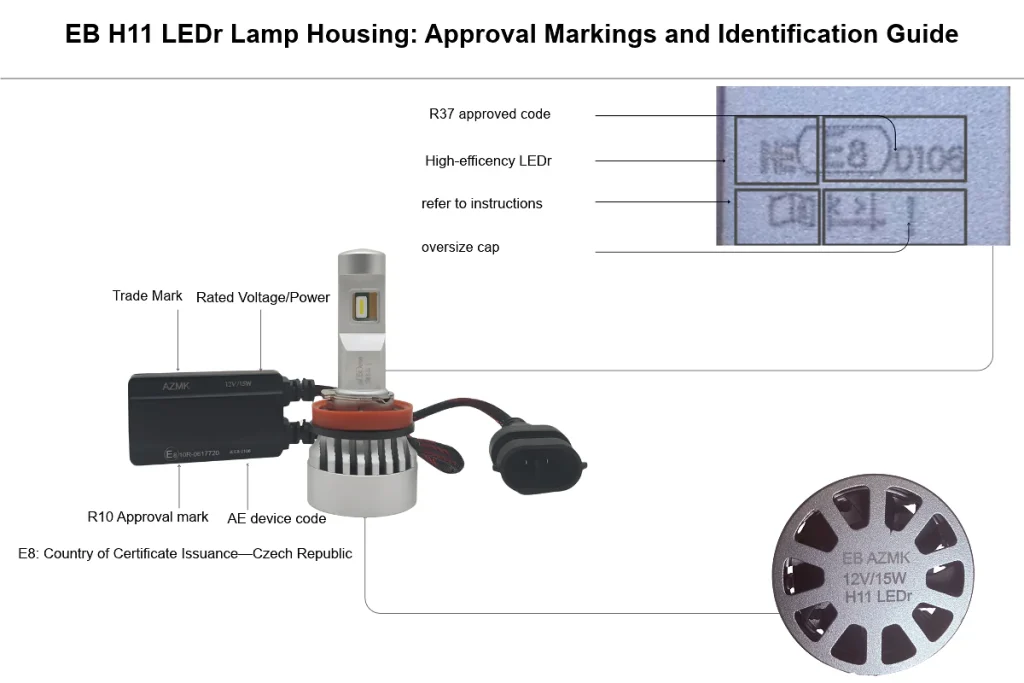
To read an E-mark on an H11 LED replacement light source (LEDr), start with three identifiers: the E-country number, the adjacent approval code, and the H11 plus LEDr designation. Then compare those identifiers with the approval communication for the same product type. The mark is a starting point for verification; it is not enough to prove that the supplied bulb, documents and intended application all match.
This page covers the reading method. Use the full R37 certificate-verification procedure for document review. See the separate guides for E1, E4 and E8 country codes, the R37 mark versus R10 mark and fake E-mark warning signs.
What Does an E-mark Actually Certify?
For an LEDr approved under UN R37, the international approval mark consists of a truncated circle containing E and the identification number of the country that granted approval, with an approval code placed close to it. The inscriptions must be clearly legible and durable.
UN R37 operates within the UNECE 1958 Agreement framework. It is not an EU-only conformity mark. The visible mark identifies an approval claim; the approval communication and associated documents establish the approved type and scope.
The E-mark is only part of the product identification. An approved LEDr light source also carries the applicant’s trade name or trademark, the relevant category designation such as H11, and the LEDr identification. Rated voltage and additional symbols apply where required. Depending on the design, additional identification can cover polarity, high-efficiency LEDr, an additional-electronics device or an oversize cap.
Packaging has separate identification and information requirements. Additional symbols, installation information, vehicle-application information and safety warnings apply when the design or approval conditions require them. Check those conditional requirements against the approval documents for the model being purchased rather than using one generic packaging checklist.
These markings help a buyer identify the claimed approved type. They do not prove that the physical sample matches its approval documents. A bulb also does not become an R37 LEDr merely because it fits an H11 socket. See LEDr vs LED Retrofit vs LED Substitute for the terminology boundary.
Which Regulation Number Is Hidden in the Mark?
The E-country number does not identify the applicable regulation. It tells you which contracting party’s authority granted the approval. The adjacent approval code identifies the approved light-source type, but the regulatory basis and full scope still need to be confirmed in the approval communication.
The approval code and the complete approval number are related identifiers, not interchangeable labels. The complete approval-number structure is governed by Schedule 4 of Revision 3 of the 1958 Agreement. A buyer should therefore record the code exactly and compare it with the corresponding information in the complete approval document instead of trying to infer the regulation, configuration or extension history from the bulb alone.
Use three comparison layers:
|
Comparison layer |
What to compare |
What to do if it is unclear |
|---|---|---|
|
Product marking |
E-country identifier, approval code, H11, LEDr and trademark |
Request a clear, uncropped photograph of the bulb or base |
|
Approval communication |
Complete approval number, corresponding code, category, type and drawings or photographs |
Request the complete document and applicable extensions |
|
Commercial and production evidence |
Approval holder, manufacturer or trademark relationship, supplier relationship and CoP evidence |
Ask for evidence explaining the relationship and pause acceptance if a material difference remains unresolved |
Names do not always have to be identical: the approval holder, manufacturer and supplier can have different roles. What matters is whether the documents explain those relationships and connect the offered product to the approved type.
UN R10 is not a substitute for UN R37. R10 addresses electromagnetic compatibility. R37 approval for an LEDr includes applicable EMC requirements, but R10 evidence alone does not establish an H11 LEDr type approval under R37. For a visual comparison, see R37 Mark vs R10 Mark on LED Bulbs.
What Does the Country Code Not Tell You?
The number following E identifies the contracting party whose authority granted the approval. It does not identify the bulb’s manufacturing country. A product made in one country can legitimately carry an approval granted by another country’s authority.
The country identifier also does not reveal the applicable UN regulation, product quality or automatic acceptance in every intended market. For the official assignment of country numbers, UN R37 refers to Annex 3 of the consolidated resolution R.E.3. Use the country-code guide for E1, E4 and E8 explanations rather than treating the number as a quality ranking.
A valid UN R37 approval for the relevant H11 LEDr type can support road use where the regulation and approval are recognized, subject to the approved application and applicable national requirements. That is narrower than saying that any bulb displaying an E-mark is road-legal.
How Do You Read the Full Mark in Four Steps?
- Locate the markings on the light source. Inspect the bulb or base, not only the retail box. If the product photograph is cropped or blurred, request a new image showing the complete marking group.
- Identify the category and LEDr designation. For the H11 example, confirm H11 and LEDr. Socket fit, shape or a catalogue description does not establish that the sample is the approved type.
- Record the E-country identifier and approval code exactly. Photograph the truncated E-circle, country number and adjacent code together. Record the trademark and other required identifiers without reconstructing unreadable characters.
- Compare the product with the approval documents. Match the visible code, category and type to the approval communication and approved drawings or photographs. Review applicable extensions, relationship evidence and CoP records separately. If a material difference remains unexplained, hold the approval claim as unverified and pause sample or packaging approval.
Where Can an Approval Be Verified Online?
Do not assume that one public website provides a complete, current lookup for every approval. The verified sources used for this guide establish the marking rules and country-number reference, but they do not establish a universal online register that can conclusively authenticate every offered product.
Start with the complete approval communication supplied for the same model. Compare the product marking, category, type, holder and approved drawings or photographs. If the record remains unclear, prepare the country identifier, approval code, complete approval number, model photographs and the exact discrepancy before contacting the approval holder or issuing authority.
For procurement, complete this comparison before approving a sample, packaging or bulk order. The supplier evidence checklist explains which supporting records to request. If the mark or document shows warning signs, use the fake E-mark guide before proceeding.
Frequently asked questions
By Jack Liu – Co-founder & Product Director, LEDOAUTO.
Regulatory review: LEDOAUTO Engineering Team – verified against official UNECE documents.
Last reviewed: 19 October 2026
References

What Evidence Should an H11 LEDr Supplier Provide Before You Place a Bulk Order?