These two H11 LEDr samples share a similar connector, but differ clearly in packaging, mounting and optical performance. EB has a 19.90% smaller package, a hanging feature and a separate metal retaining spring; Luxfighter has neither a hanging slot nor a separate retaining spring. EB also delivers thinner emitting geometry, higher right-side and peak illuminance, and a lower surface temperature, while Luxfighter has a lighter empty package and quieter fan.
Compared samples: one EB H11 LEDr lamp and one Luxfighter P36-H11 LEDr lamp. This comparison uses the photographs and measurements from the EB H11 LEDr review and Luxfighter H11 LEDr review.
Test conditions
Both lamps operated at 13.2 V in a 26°C environment. Illuminance was recorded at the same E-Mark panel points from 3.5 m after a 30-minute warm-up. Emitting-area surface temperature was recorded after 30 minutes, and fan noise was measured from 3.5 cm.
Key Comparison Points
- Packaging: EB uses 19.90% less box volume and includes a hanging feature for peg-hook display. Luxfighter’s empty package is 7 g lighter but has no hanging tab or Euro-slot.
- Lamp construction: Both use fan cooling and external drivers. EB includes a separate metal retaining spring; Luxfighter does not.
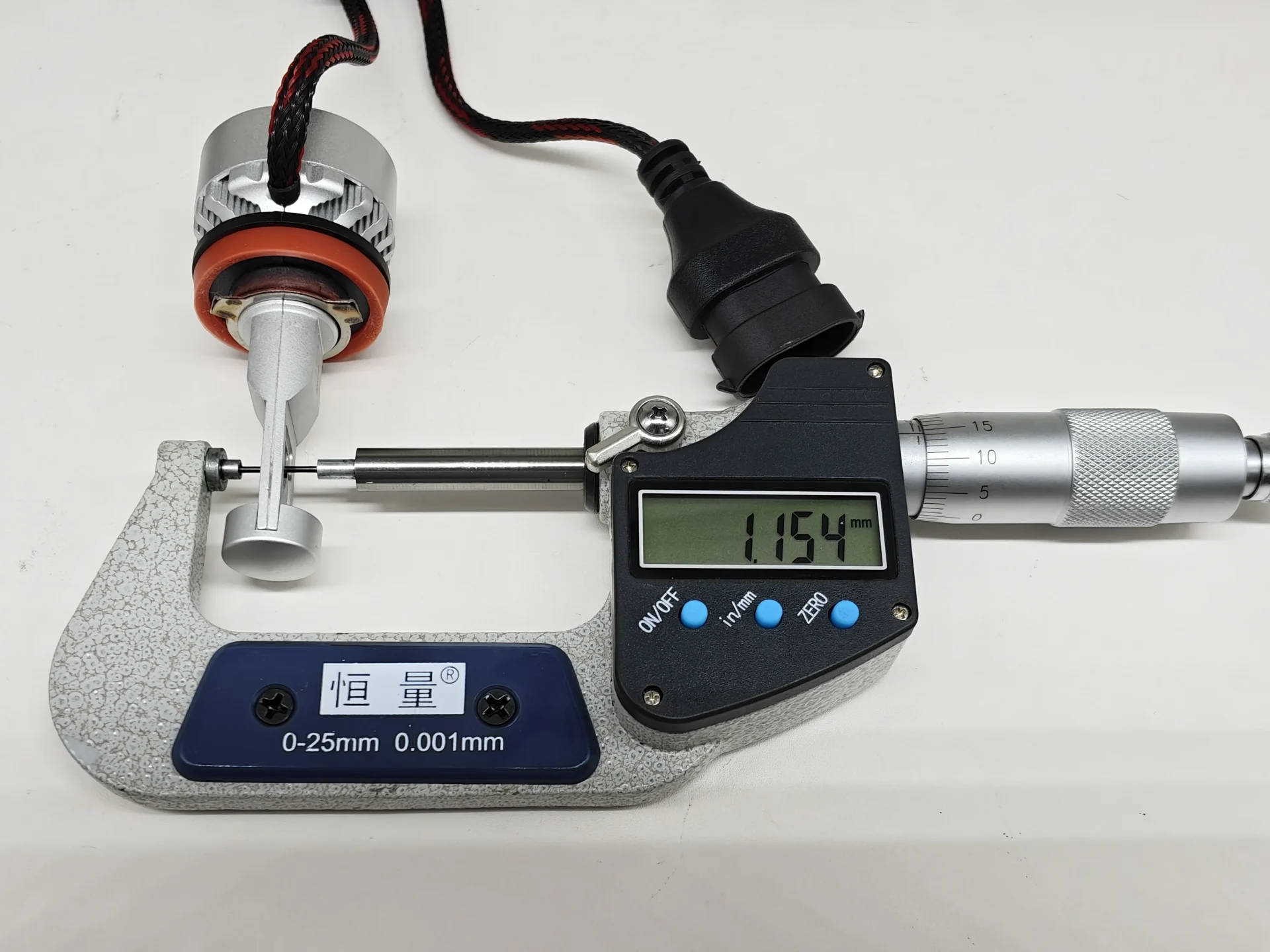
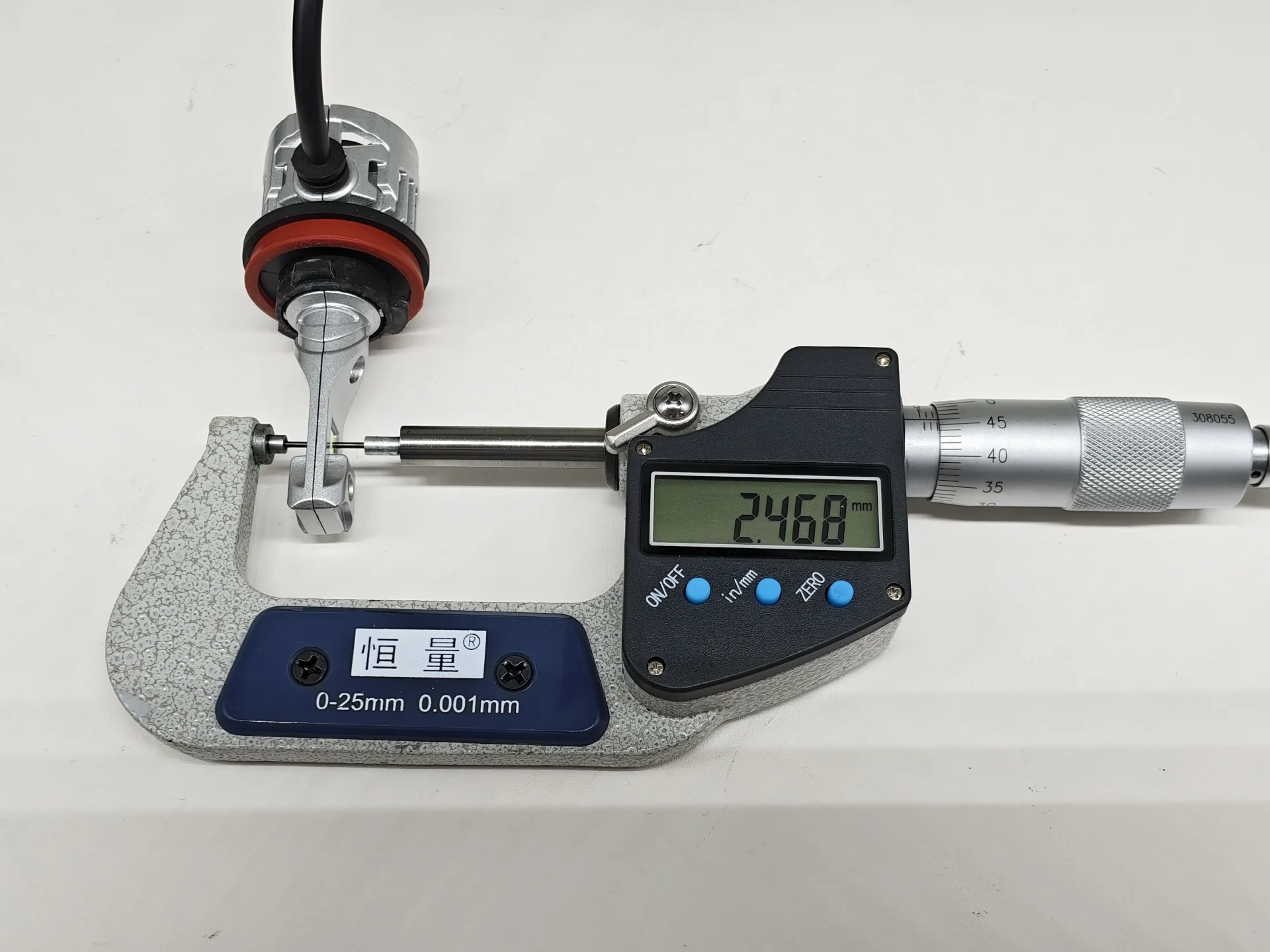
- Emitting geometry: EB’s 1.154 mm opposing-surface distance is 53.24% thinner than Luxfighter’s 2.468 mm structure.
- Box system: EB covers B1–B3 more fully and keeps Area D dark. Luxfighter’s emitting band sits higher, extends beyond the upper boundary and produces visible light in Area D.
- Beam and illuminance: EB records higher values at 25R, 50R, 75R and EMAX, with a slightly lower B50L reading. Luxfighter is higher through the centre-left field.
- Temperature and noise: EB’s emitting surface is 42.7°C cooler after 30 minutes. Luxfighter’s fan is 3.3 dBA quieter at 3.5 cm.
Packaging Section
Package dimensions and empty-box weight show how much space and transport weight the packaging adds to bulk orders.
1.Package and included contents
The front views compare the heat-sink, cable and external-driver designs.
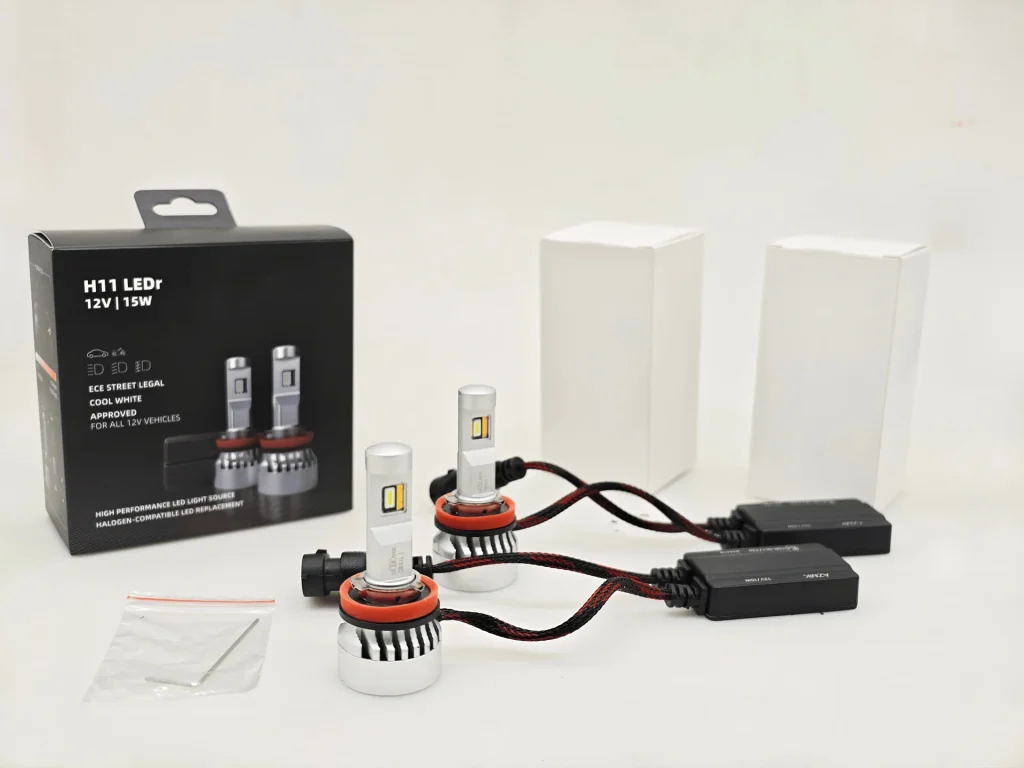
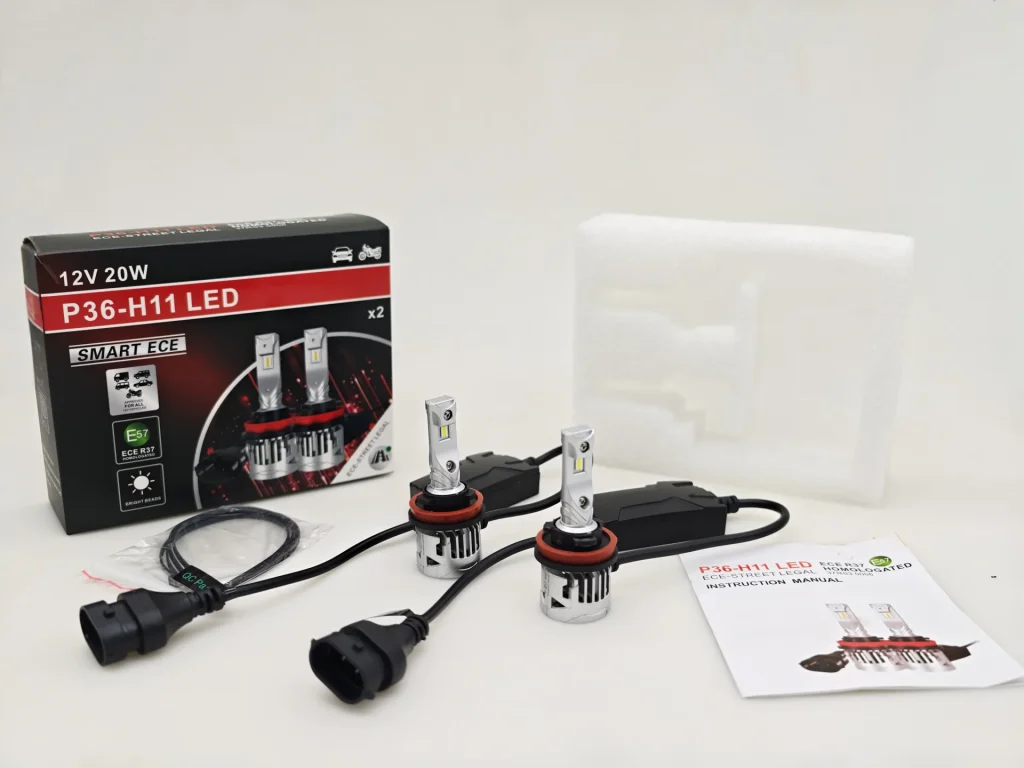
EB is shown with two lamps, two external drivers, two plain inner boxes and an accessory bag. Its outer package includes a hanging feature for direct peg-hook display. Luxfighter includes two lamps with driver modules and H11 leads, foam support, a cable tie and printed instructions, but its tested outer pack has no hanging tab or Euro-slot.
2.External package dimensions
Smaller external volume can reduce the space required for stock and support denser carton packing, depending on carton layout.
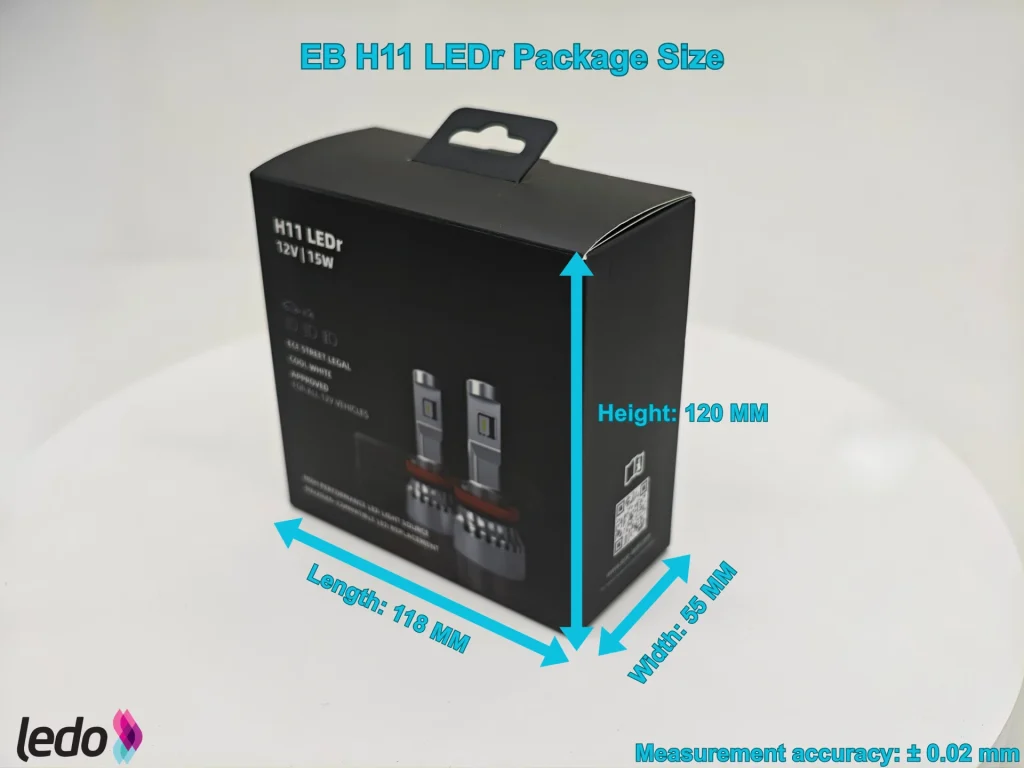
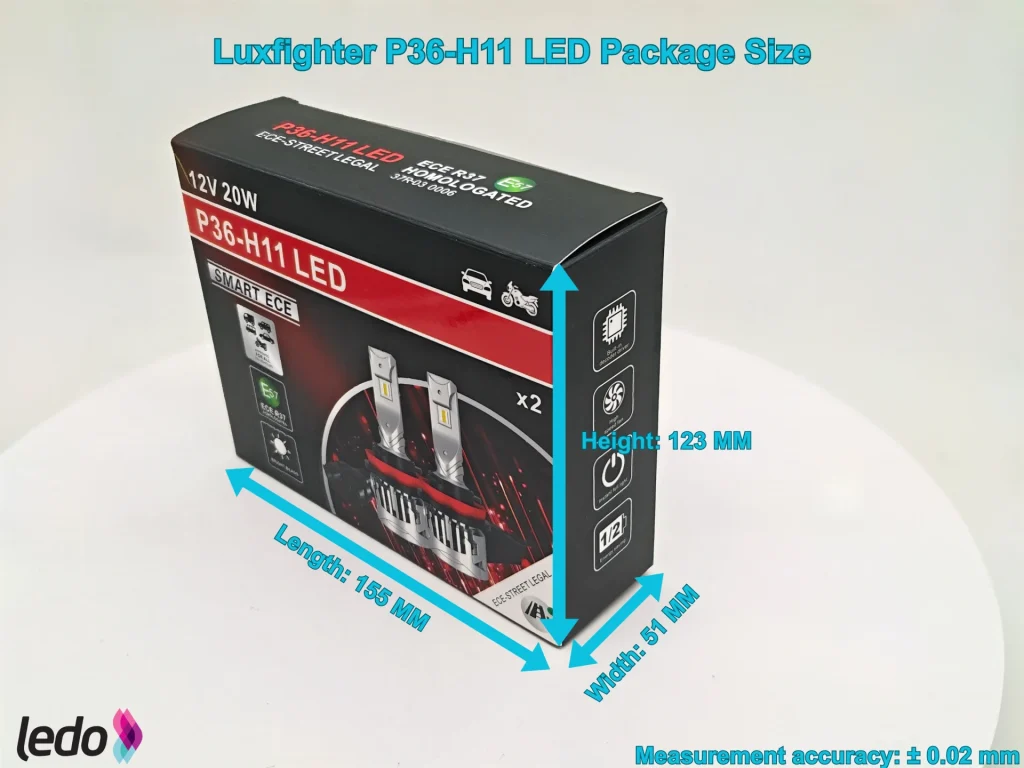
EB measures 118 × 55 × 120 mm, approximately 0.779 L. Luxfighter measures 155 × 51 × 123 mm, approximately 0.972 L. EB’s nominal external volume is 19.90% smaller than Luxfighter’s.
3.Empty-package weight
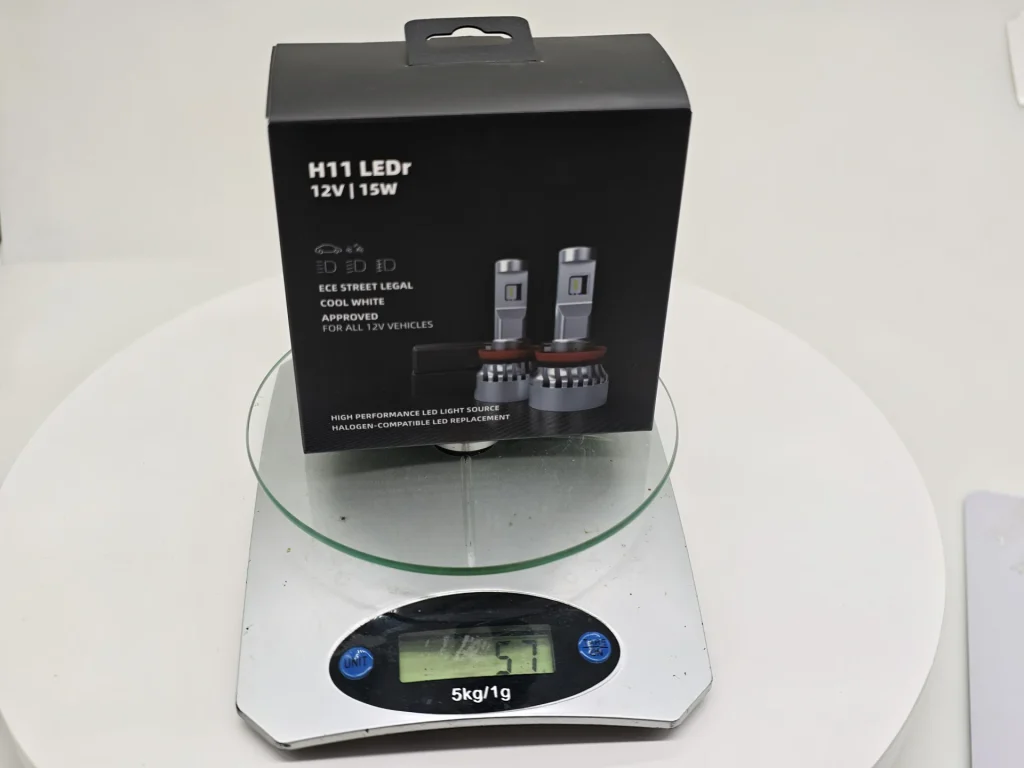
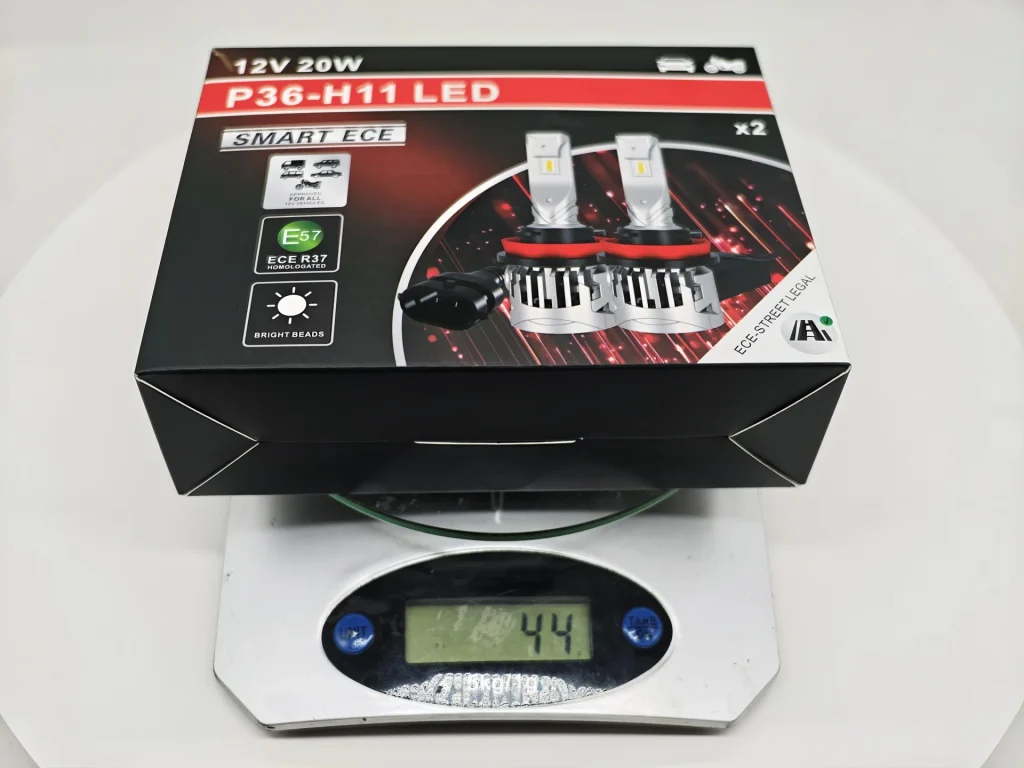
The empty packages weigh 51 g for EB and 44 g for Luxfighter. Luxfighter is 7 g lighter per box; the smaller EB package does not also have the lower packaging weight.
| Packaging Size, Weight and Contents |
|---|
| Item | EB | Luxfighter | Difference |
|---|---|---|---|
| External dimensions | 118 × 55 × 120 mm | 155 × 51 × 123 mm | EB is shorter and slightly lower; Luxfighter is narrower. |
| Nominal external volume | 0.779 L | 0.972 L | EB is 19.90% smaller. |
| Empty-package weight | 51 g | 44 g | Luxfighter is 7 g lighter. |
| Kit layout | Lamps, separate drivers and two inner boxes | Lamps, driver modules, foam support, a cable tie and printed instructions | The packages use different internal layouts. |
| Hanging-display feature | Packaging hook present for direct peg-hook display | No hanging tab or Euro-slot on the tested pack | EB supports peg-hook display; Luxfighter may require alternative retail packagi |
EB’s nominal package volume is 19.90% smaller, saving approximately 19.35 L of packaging space per 100 boxes. Luxfighter’s empty package is 7 g lighter, saving 0.7 kg per 100 boxes. EB also includes a hanging feature for direct peg-hook display, while the tested Luxfighter pack does not. Actual freight savings depend on carton configuration and the carrier’s pricing method.
Lamp Construction Comparison
Both samples have a keyed H11 mounting base, a red sealing ring, rear cooling fins and an external driver. The comparison below separates the base dimensions from the retaining-spring detail, because they describe different parts of the mounting structure.
1.Lamp and external-driver overview
The images show the connector face used by each sample.
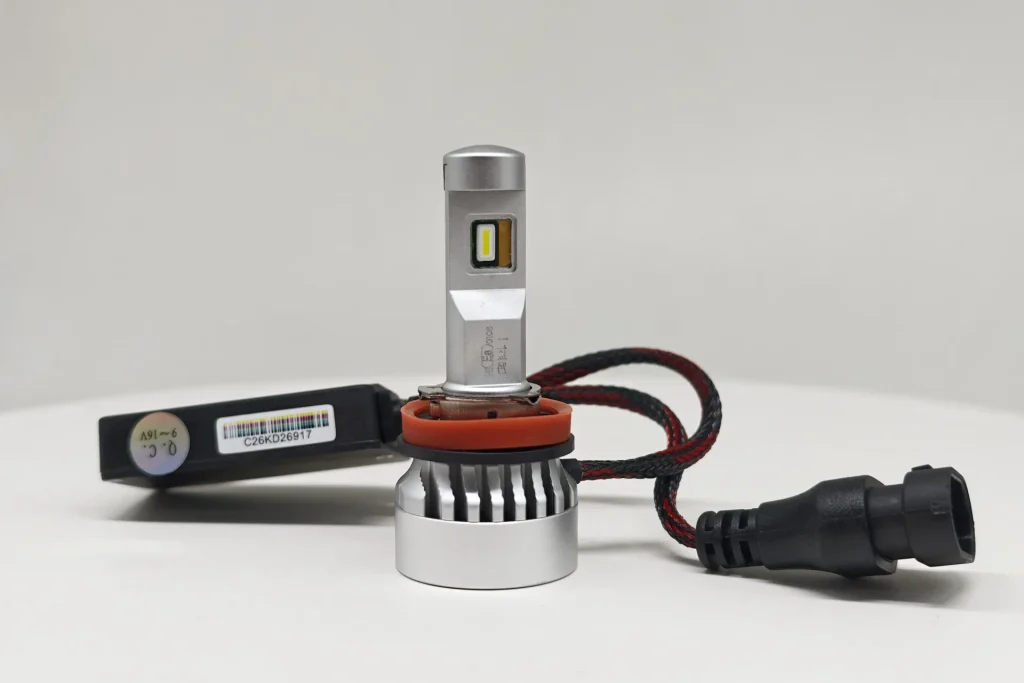
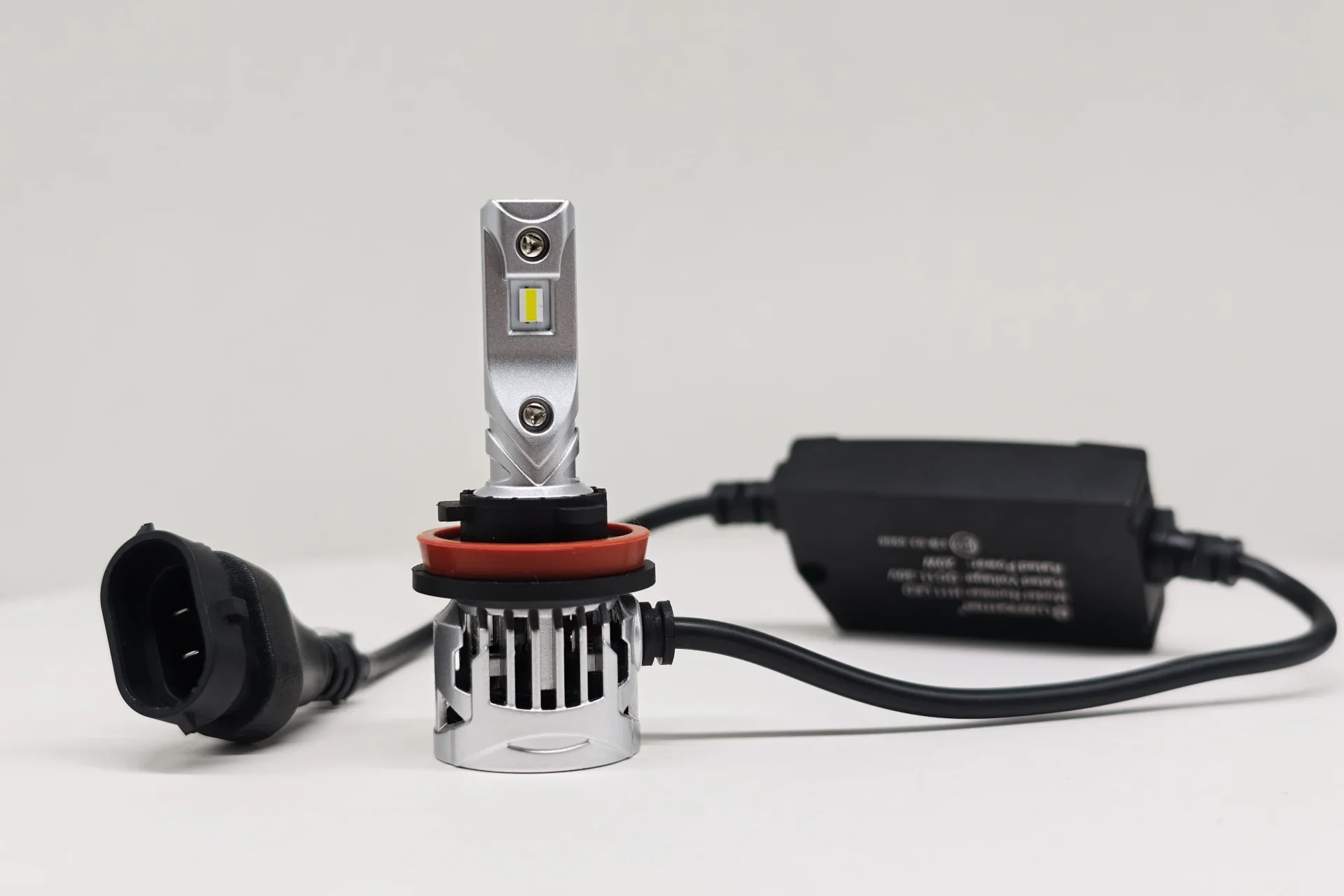
EB uses a cylindrical rear heat sink with braided leads and a flat rectangular driver housing. Luxfighter uses an open, slotted rear cooling assembly, smooth black leads and a separate moulded driver housing. Both place the driver outside the emitter blade, so the lamp, cables and driver all form part of the assembly dimensions.
2.H11 Connector Interface
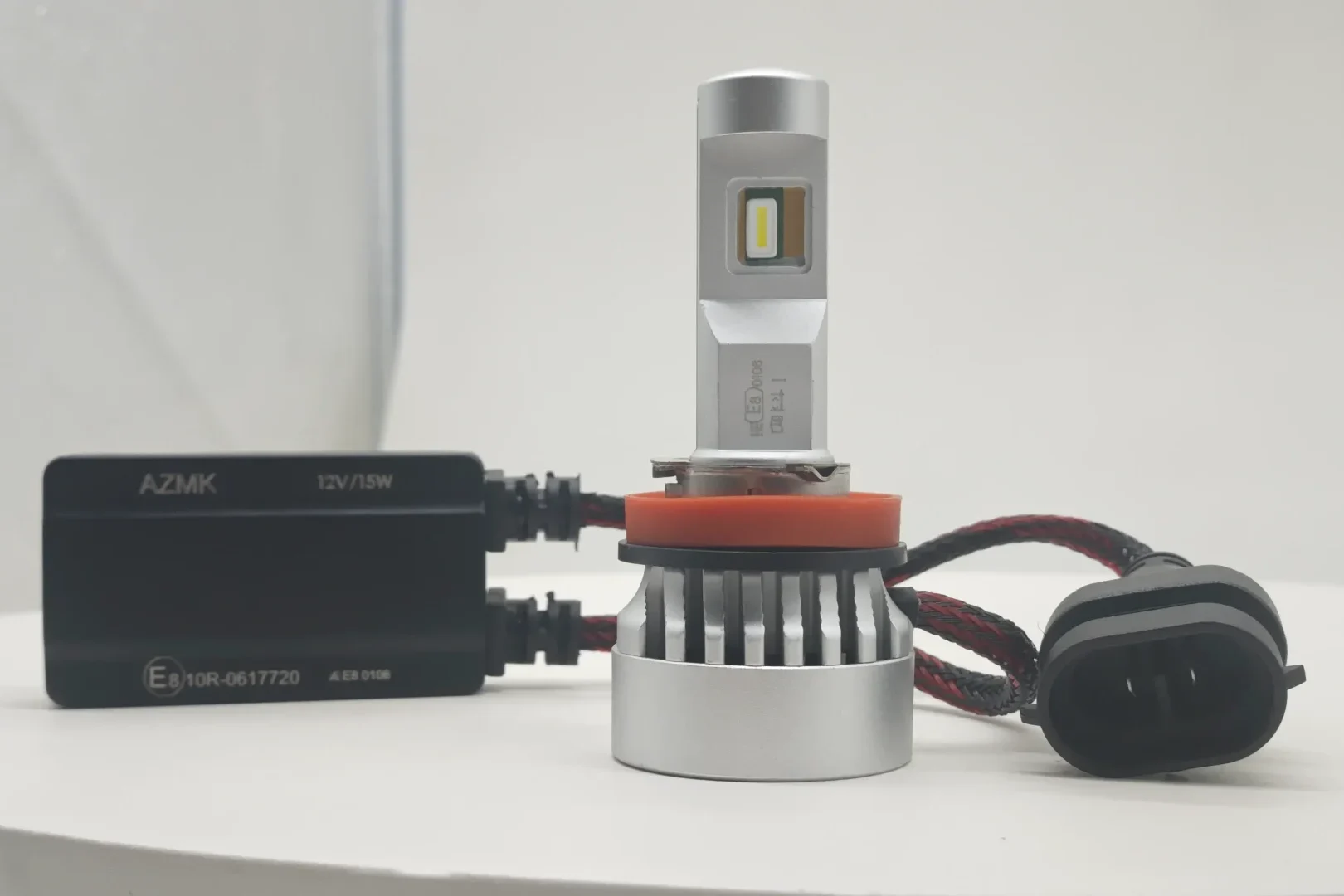
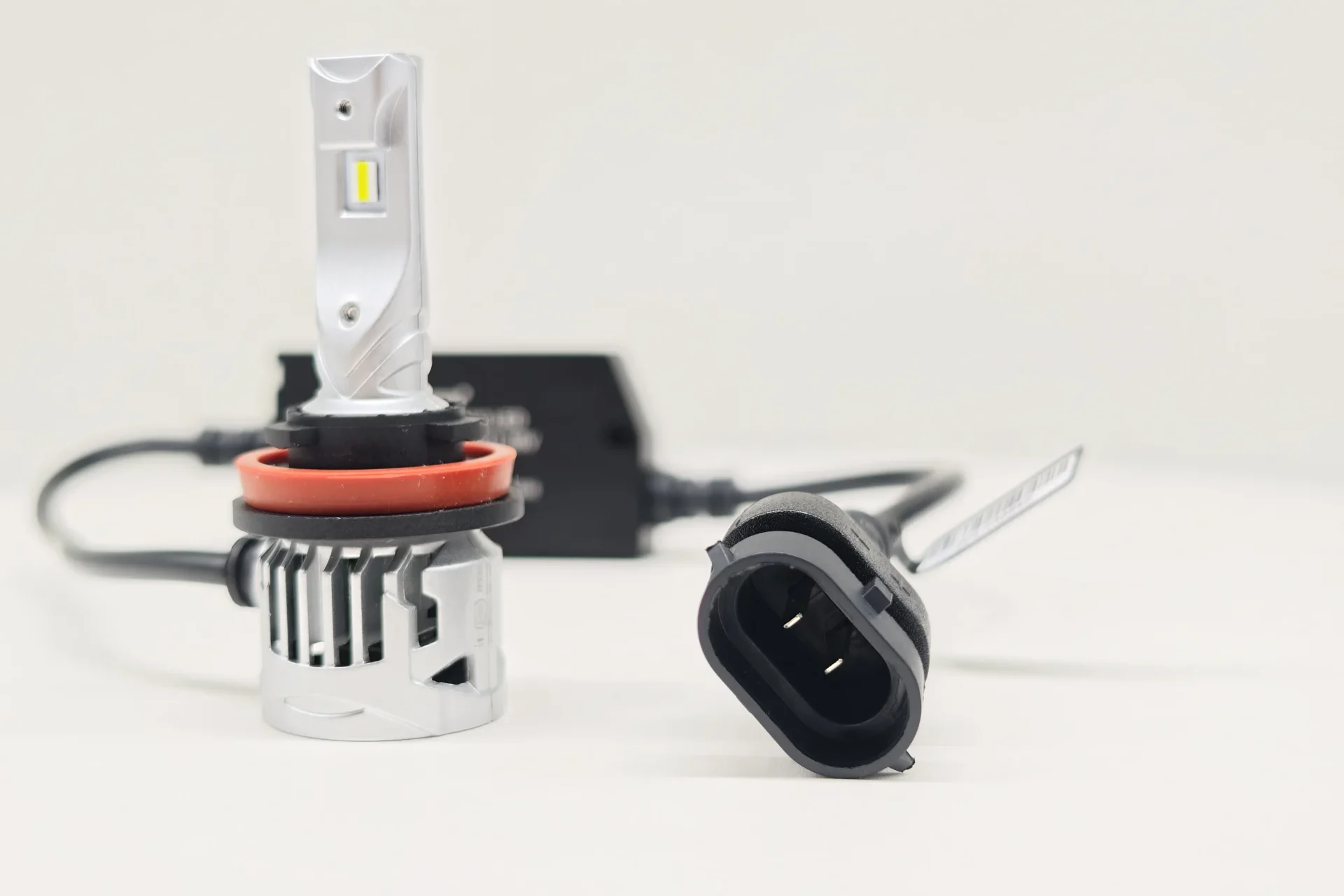
Both samples show an oval, keyed two-pin H11 connector with a central divider.
3.PGJ19-2 base and locating features
UN Regulation No. 37 requires an LED replacement light source to use the same cap designation as its counterpart filament category. The H11 LEDr category specification identifies that cap as PGJ19-2 and refers its interface dimensions to IEC 60061 sheet 7004-110-3.
| H11 Base Standard Reference |
|---|
| Reference | What it specifies | Structural effect | Purpose |
|---|---|---|---|
| UN R37 and the H11 LEDr category sheet | H11 LEDr uses the H11 PGJ19-2 cap designation. | Defines the applicable H11 mounting interface. | Keeps the replacement source within the H11 category configuration. |
| IEC 60061-1, sheet 7004-110-3 | Defines the PGJ19 cap dimensions and locating features relevant to interchangeability, including the three-tab interface. | Controls the installation direction and the cap’s reference position in the holder. | Ensures dimensional compatibility between the cap and the corresponding PGJ19 holder. |
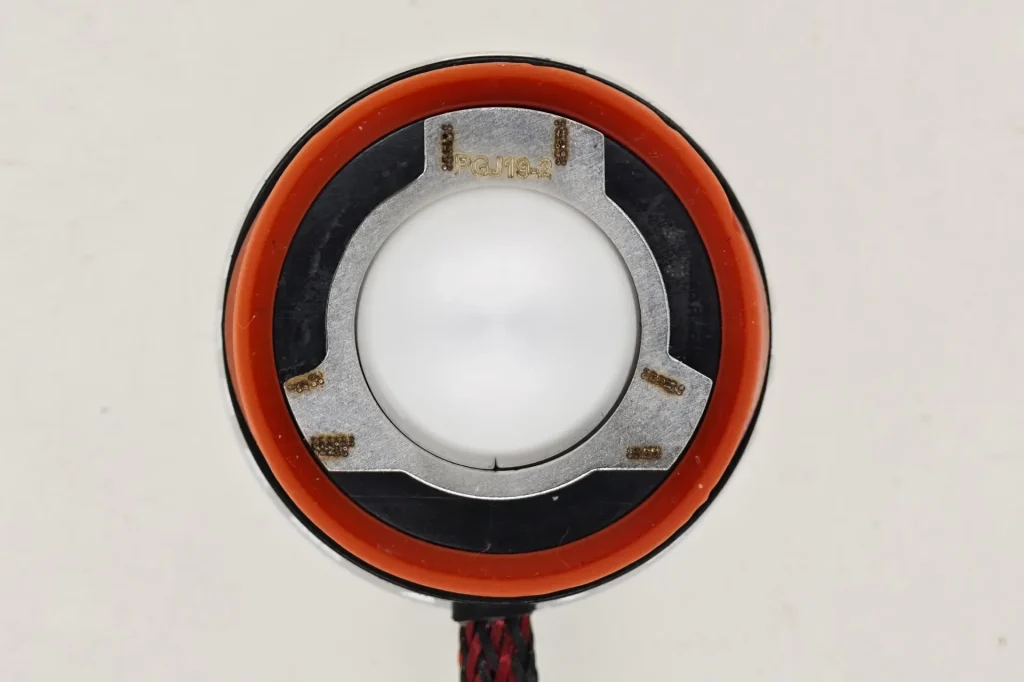
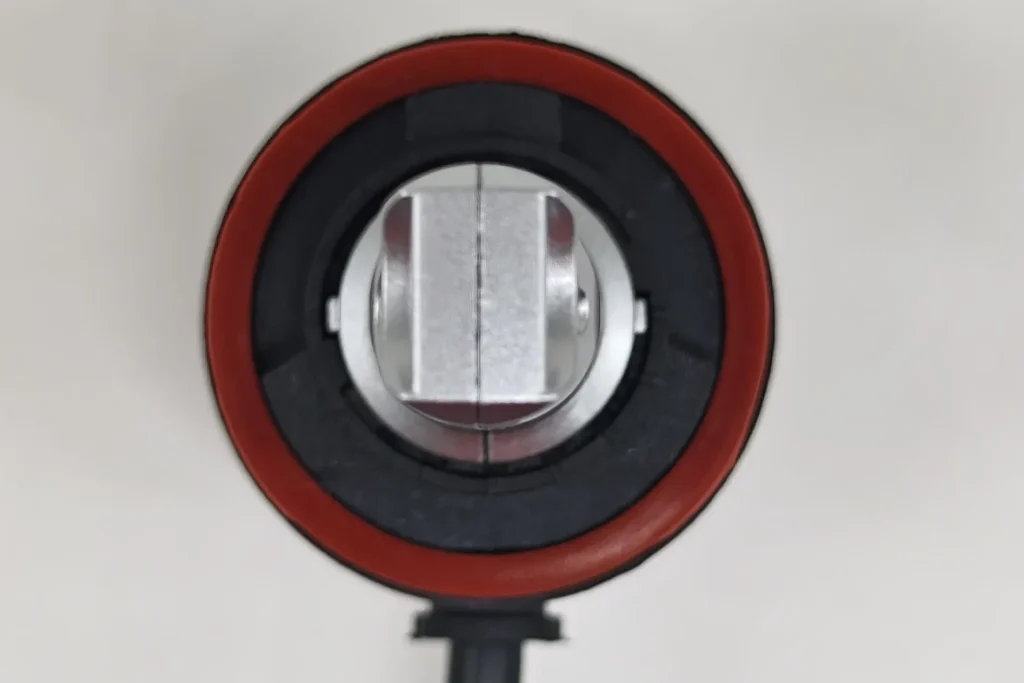
EB’s top view shows metal locating features around the blade. Luxfighter has a black keyed H11 mounting collar. Both use a red sealing ring. The photographs record the visible locating structures.
4.Base installation-section measurement
| Why Measure Pillar Thickness | Main Impact | Relevance to Actual Headlight Performance |
|---|---|---|
| Light obstruction | The pillar can block part of the light emitted sideways or at oblique angles from the LED | An excessively thick pillar may block certain emission angles, resulting in incomplete angular light distribution or local dark areas |
| Heat transfer | The pillar is also part of the main thermal path from the LED chip to the heat sink | Its cross-section, material and internal structure affect how efficiently heat is transferred, influencing junction temperature and sustained light output |
| Structural strength and stability | The pillar provides mechanical support for the LED chip, PCB or substrate | An excessively thin pillar may reduce rigidity and increase the risk of displacement or deformation during assembly, vibration or thermal cycling |
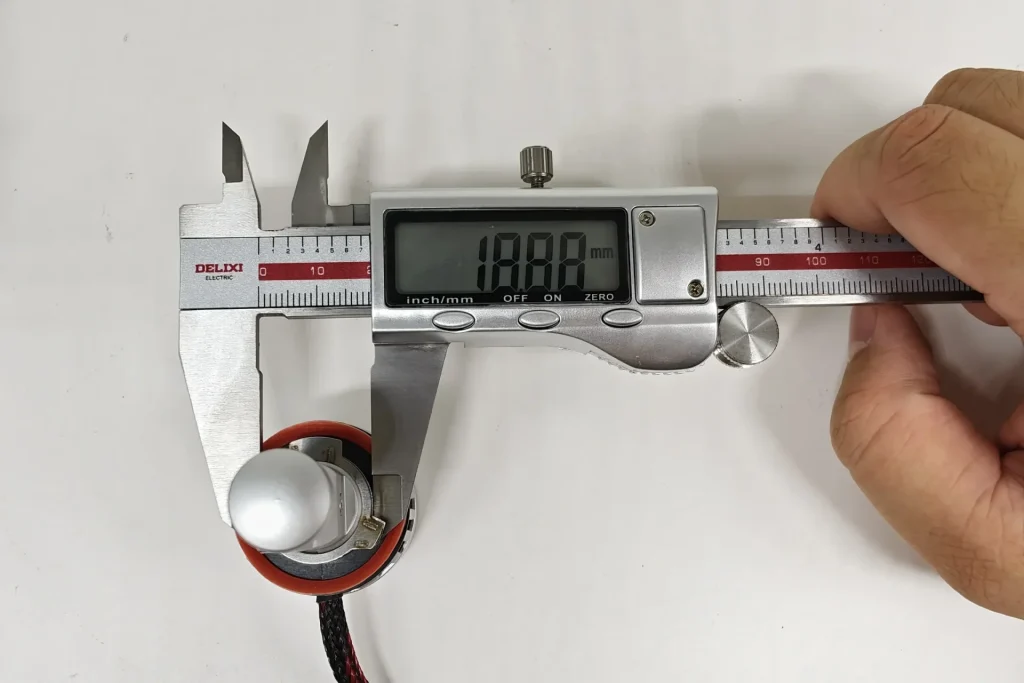
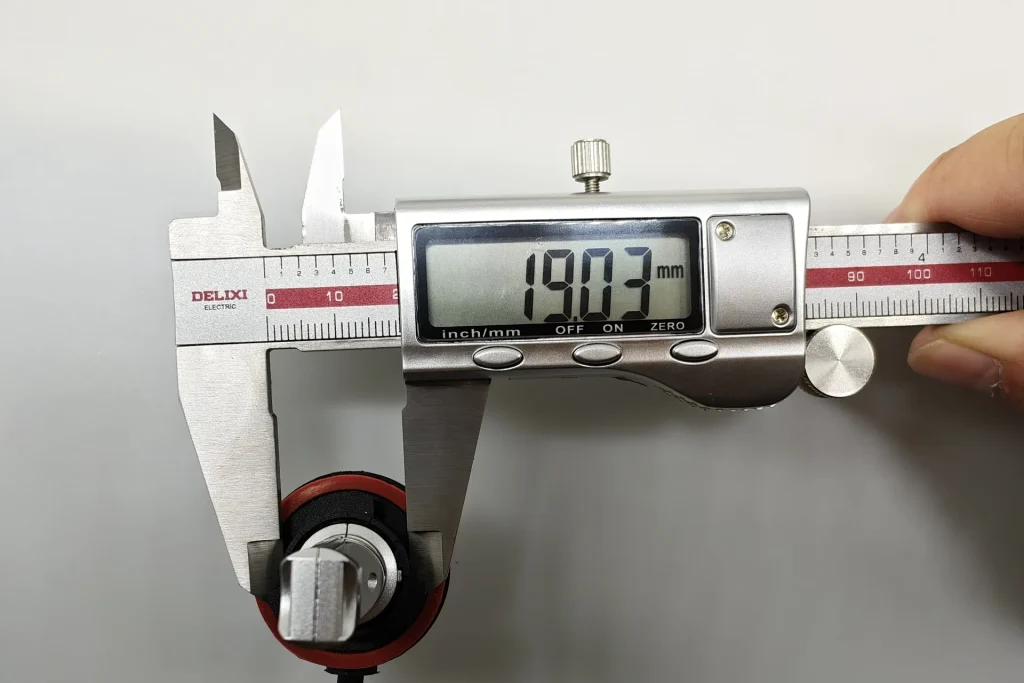
In terms of installation dimensions, these two products are very similar. The EB is slightly smaller, but the difference is minimal. Based on this measurement alone, it is not possible to conclude that either product has a clear advantage in terms of installation compatibility, structural strength, or optical performance.
5.Metal retaining spring
A retaining spring provides elastic preload at the mounting interface.
| Retaining-Spring Standard Reference |
|---|
| Reference | What it specifies | Structural effect | Purpose |
|---|---|---|---|
| IEC 60061-2, PGJ19 holder and connector sheet 7005-110-3 | Defines the corresponding PGJ19 holder and connector interface, including the retaining arrangement used with the cap. | Affects whether the cap remains seated in its installed position. | Helps retain the light source after the keyed base has located it. |
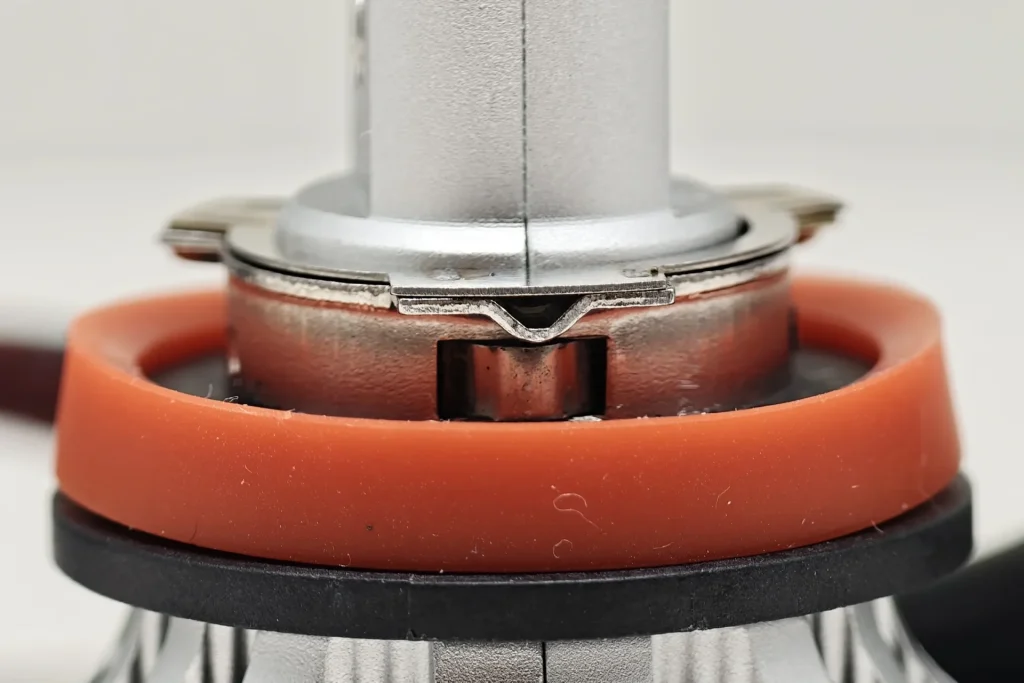
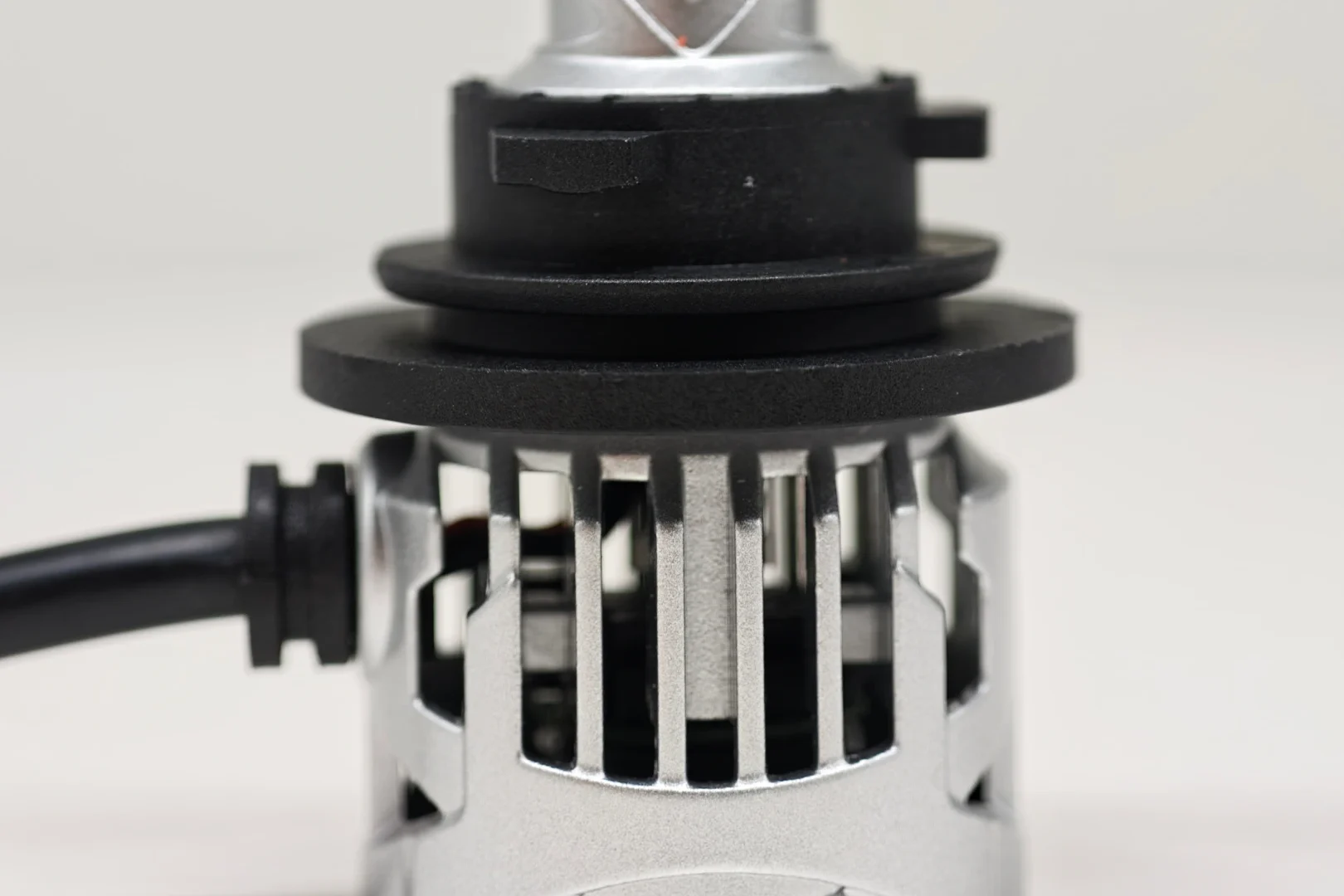
EB has a separate metal retaining spring beneath the flange. No separate metal retaining spring is visible on the tested Luxfighter sample.
| Lamp-Construction Comparison |
|---|
| Item | EB | Luxfighter | Practical significance |
|---|---|---|---|
| Installation-section diameter | 18.88 mm | 19.03 mm | The 0.15 mm difference is too small to create a clear fitment advantage by itself. |
| Locating structure | Metal locating features | Black keyed H11 collar | Both establish the lamp’s installation direction but use different visible constructions. |
| Sealing structure | Red sealing ring | Red sealing ring | Both seal the mounting interface using the same visible principle. |
| Metal retaining spring | Separate spring present | No separate spring visible | EB adds elastic preload to help keep the lamp seated after the base establishes its position. |
| Rear cooling assembly | Cylindrical heat sink and fan | Open slotted heat sink and fan | Both use active cooling, but their rear profiles occupy different shapes of installation space. |
| Cable | Braided outer covering | Smooth black covering | EB adds a braided outer sheath; Luxfighter uses a simpler smooth lead. |
| External driver | Flat rectangular housing | Separate moulded housing | Both require space outside the lamp body, but the driver shapes affect placement. |
The 0.15 mm installation-section difference is minor; the meaningful distinction is how the lamps are retained and arranged behind the base. EB includes a separate metal spring that adds preload after the keyed base is positioned, while no separate spring is visible on the tested Luxfighter sample. EB also combines braided leads, a cylindrical cooling assembly and a flat driver housing, giving it a well-defined and protected modular construction. Luxfighter uses a more open cooling body and smooth leads. For buyers who prioritise secure retention and protected cable construction, EB provides the stronger structural package.
LED Emitting Structure and Box System
The close-up images show the visible emitting structure, while the micrometer readings measure the distance between the opposing emitting surfaces. The Box-system images record the position of the emitting area within the reference frame. The evaluation criteria follow the H11 LEDr category sheets associated with UN Regulation No. 37; see the UNECE H11 LEDr Configuration-2 reference.
1.LED emitting-surface close-up
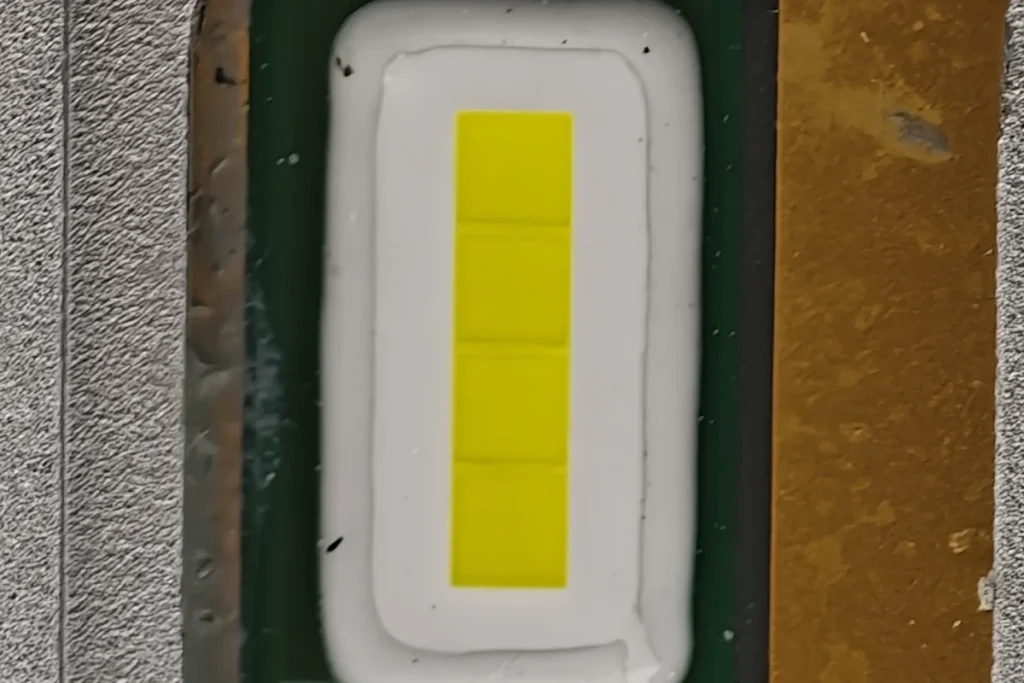
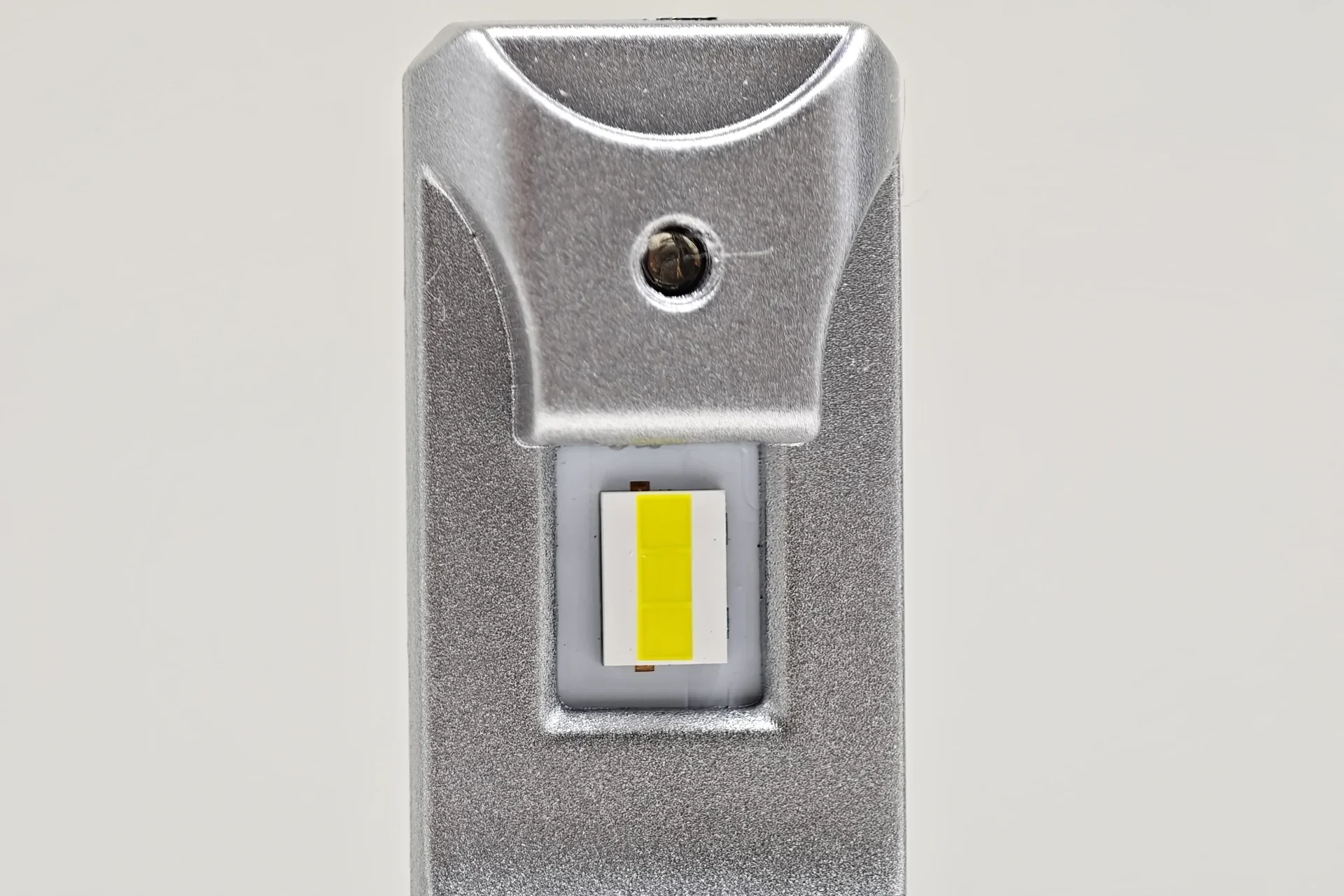
Both products use a rectangular phosphor emitting area, but the internal structure is visibly different. EB shows four distinct emitting segments, while Luxfighter shows three. EB’s emitting area sits within a larger recessed window, whereas Luxfighter uses a narrower white rectangular package mounted inside the metal blade opening.
2.Distance between opposing LED emitting surfaces
The distance between the two opposing LED emitting surfaces affects how compact the light source is. A thinner emitting structure can help the LED better match the focal geometry of a headlamp originally designed for a filament bulb, which may improve beam control.
For LED emitting surfaces, the UNECE Official specification defines this distance as parameter z and requires it to be no more than 2.9 mm.
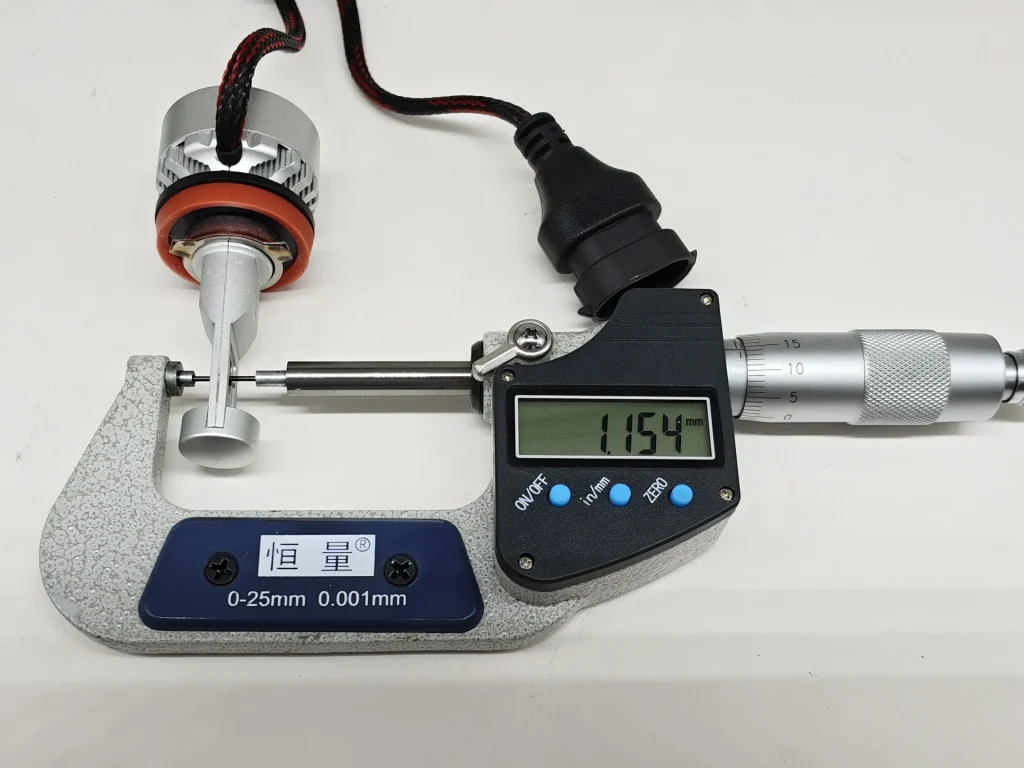
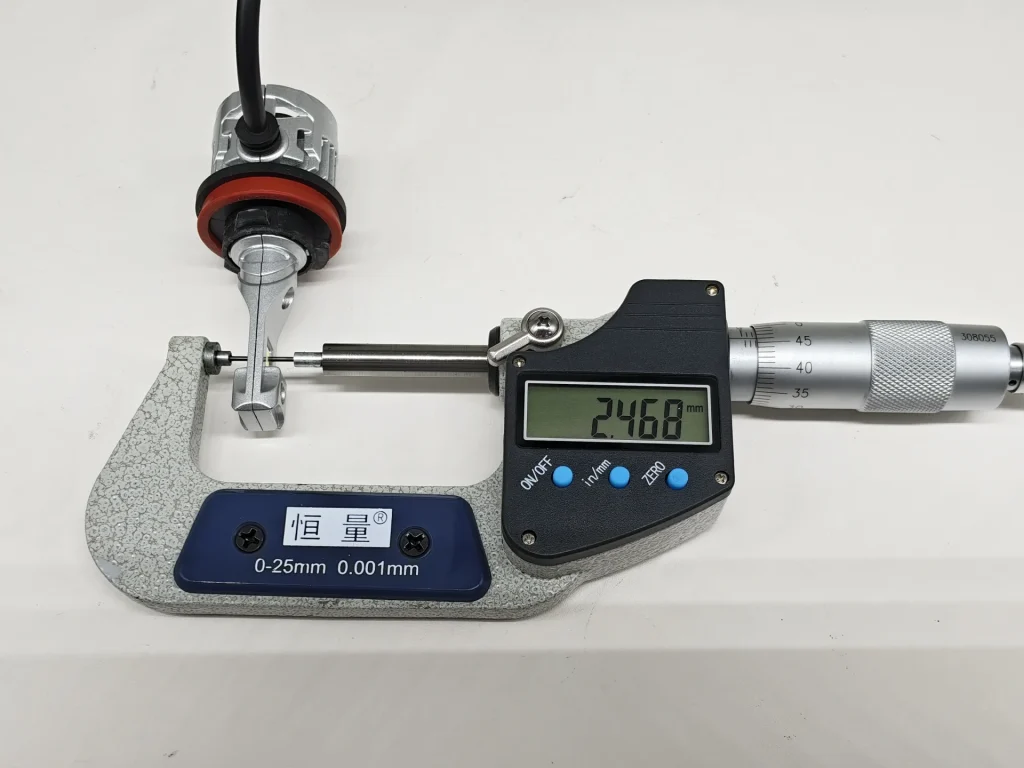
EB measures 1.154 mm and Luxfighter 2.468 mm. EB is 1.314 mm thinner, or 53.24% lower than Luxfighter. Both measurements fall below the 2.9 mm dimensional reference. EB therefore has the thinner measured dual-sided geometry.
3.Box system reference-frame check
| Area | UNECE requirement | What the area represents | Why it matters |
|---|---|---|---|
| A+B+C | ≥90% of total luminous flux E | Main effective emitting region | Shows whether most emitted light remains inside the defined region. |
| Area A | ≤10% of A+B+C | One side of the core emitting region | Limits excessive flux on one side of Area B. |
| Area B | ≥72% of A+B+C | Core emitting region | Requires most effective flux to remain in the central region. |
| B1, B2, B3 | Each ≥15% of Area B | Three subdivisions of Area B | Checks that the core output is distributed across all three sections. |
| Area C | ≤22% of A+B+C | Opposite side of the core emitting region | Limits excessive flux beyond the other side of Area B. |
| Area D | Required contrast between A+B+C and D | Region outside the main emitting area | Controls unwanted emission outside the intended region. |
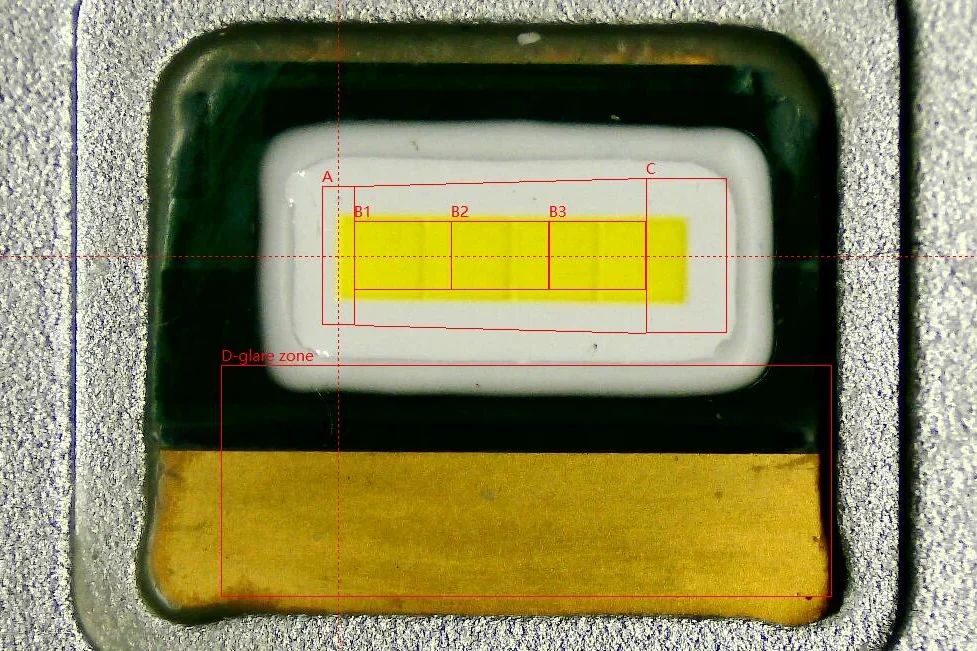
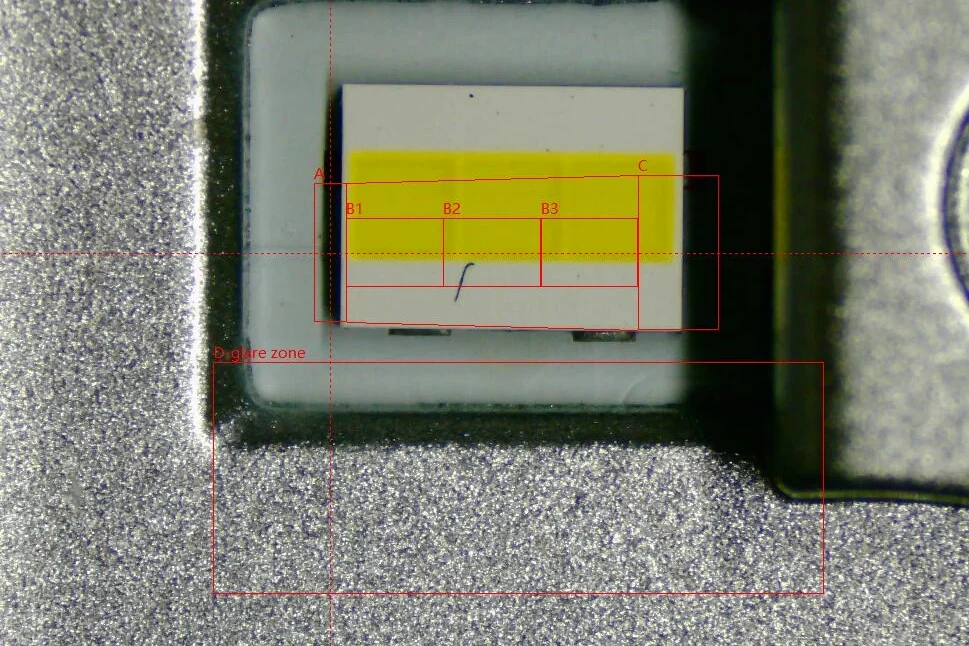
EB’s emitting window overlaps the vertical span of B1–B3. In the Luxfighter photograph, the yellow window sits higher: its upper part extends above the A–C frame, while the lower portions of the B subdivisions cross the white package beneath the yellow area.
4.Box system with the emitting area illuminated
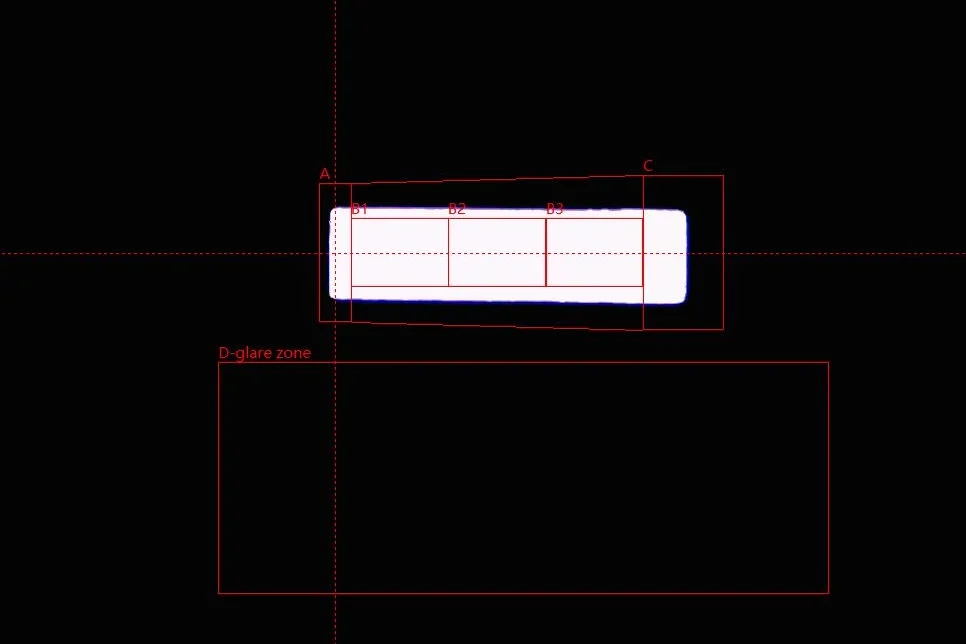
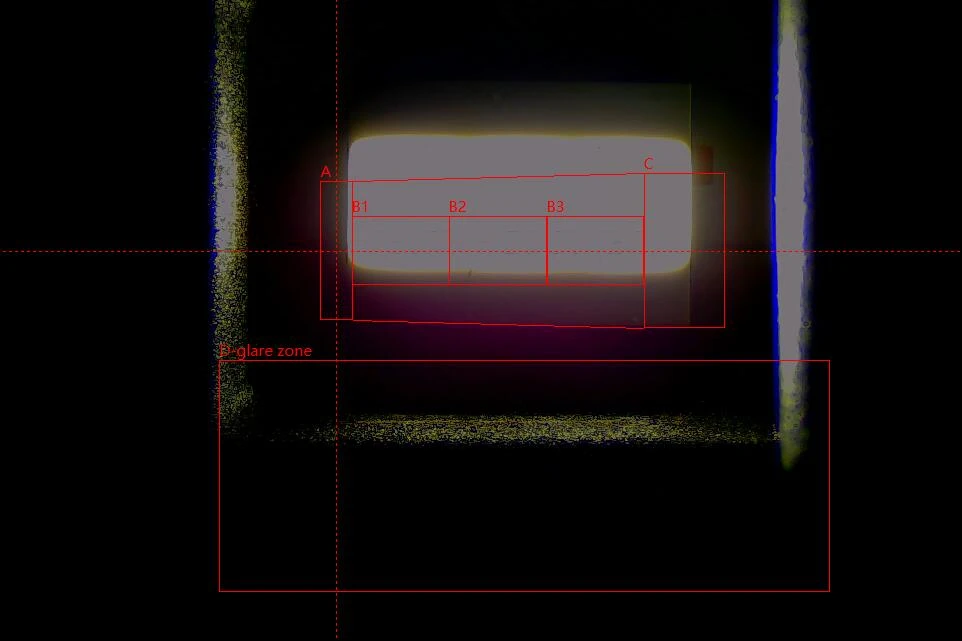
When lit, EB forms a horizontal band that covers B1–B3 through their full marked height, and D remains dark. Luxfighter illuminates all three B subdivisions but the band extends substantially above the upper A–C boundary and leaves a dark strip near the lower B boundary. A horizontal band of scattered light and bright surrounding edges are also visible within D.
| Box-System Image Comparison |
|---|
| Area | Reference focus | EB observation | Luxfighter observation |
|---|---|---|---|
| A+B+C | Main emitting envelope | Bright band remains within the upper framework. | Bright band extends above the upper boundary of the framework. |
| Area A | Emission on one side of B | A small part of the band reaches into A. | Limited visible emission appears in the narrow A region. |
| Area B | Core emitting region | Band covers the marked height of B. | Band sits higher, leaving part of the lower B region less covered. |
| B1 / B2 / B3 | Distribution across all three subdivisions | One continuous illuminated band spans all three. | All three are illuminated, but the band is concentrated toward their upper portions. |
| Area C | Emission beyond the other side of B | Right end of the band extends into C. | Right end also extends into C while remaining higher in the frame. |
| Area D | Emission outside the main region | Visually dark; no obvious isolated bright marks. | A horizontal light band, bright surrounding edges and diffuse illumination are visible. |
| Item | EB | Luxfighter | Result |
|---|---|---|---|
| Distance between opposing emitting surfaces | 1.154 mm | 2.468 mm | EB is 1.314 mm smaller (53.24%). |
EB’s opposing-surface distance is 1.314 mm smaller than Luxfighter’s, giving it a thinner and more compact dual-sided emitting structure. In the illuminated Box images, EB’s emitting band aligns more closely with B1–B3 and keeps Area D visually dark. This gives the headlamp optics a more concentrated, better-positioned light source to work with, supporting cleaner light control around the intended emitting region. Luxfighter’s band sits higher, with visible light extending into Area D. For buyers, choosing EB provides a more compact emitting structure and more controlled visible emission for H11 LEDr product integration.
Beam Pattern and Illuminance Comparison
White-wall photographs show the cutoff and bright-area shape. Rainbow maps make the visible distribution easier to compare, while the nine-point measurements quantify the differences.
1.White-wall beam pattern
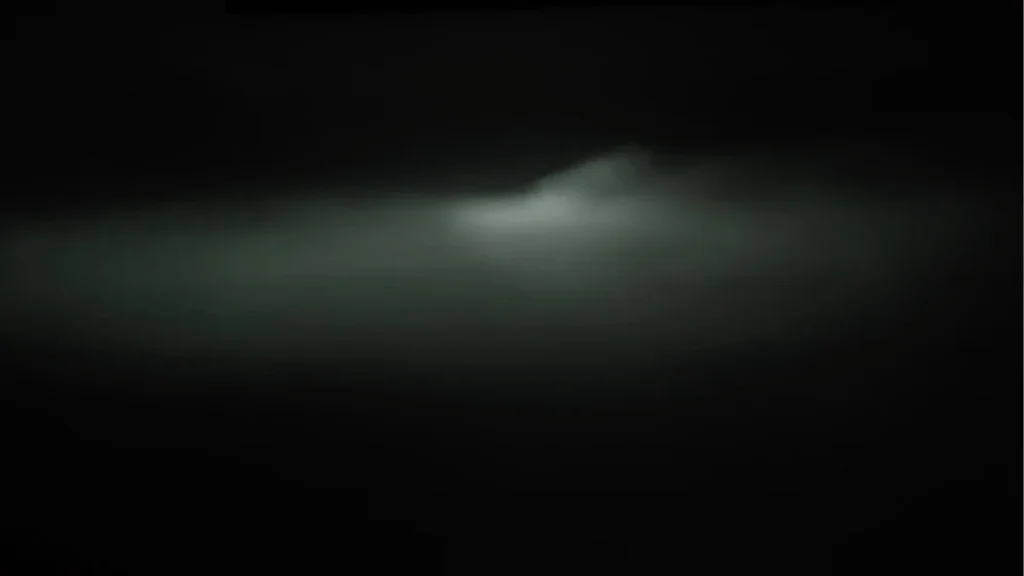
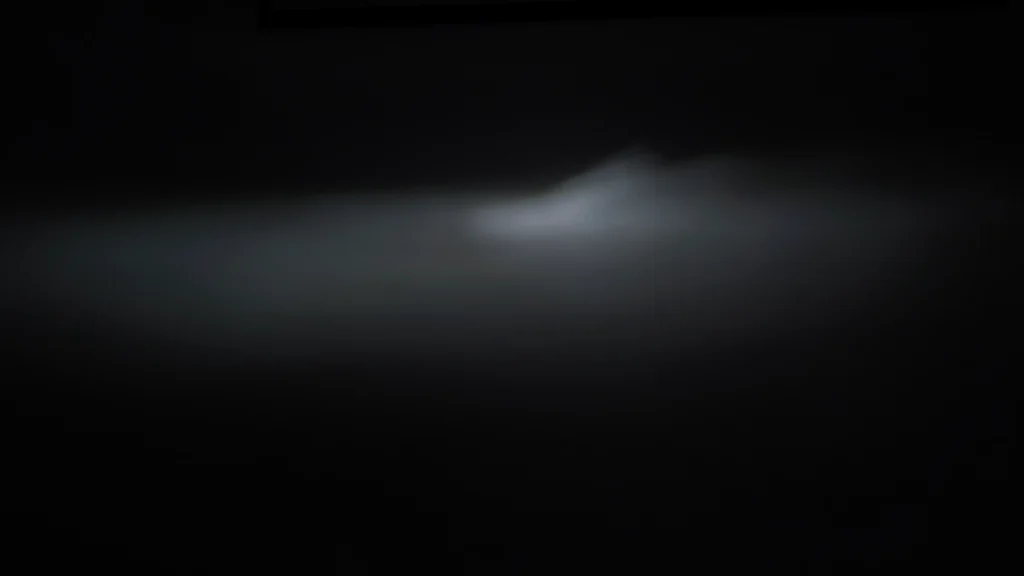
Both lamps form a recognizable low-beam pattern, but EB keeps the hotspot lower and more compact, leaving the area above the cutoff cleaner. Luxfighter places more light around the rising section and shows greater upward spread.
This result matches the Box-system images. EB’s illuminated band remains within the upper framework, covers the marked height of Area B and spans B1–B3 continuously, while Area D stays visually dark. Luxfighter’s band sits higher, extends above the upper boundary and leaves part of the lower B region less covered. Visible light also appears in Area D. Together with EB’s thinner opposing-surface distance—1.154 mm versus 2.468 mm—these differences correspond with EB’s cleaner cutoff control.
2.Rainbow map and hotspot distribution
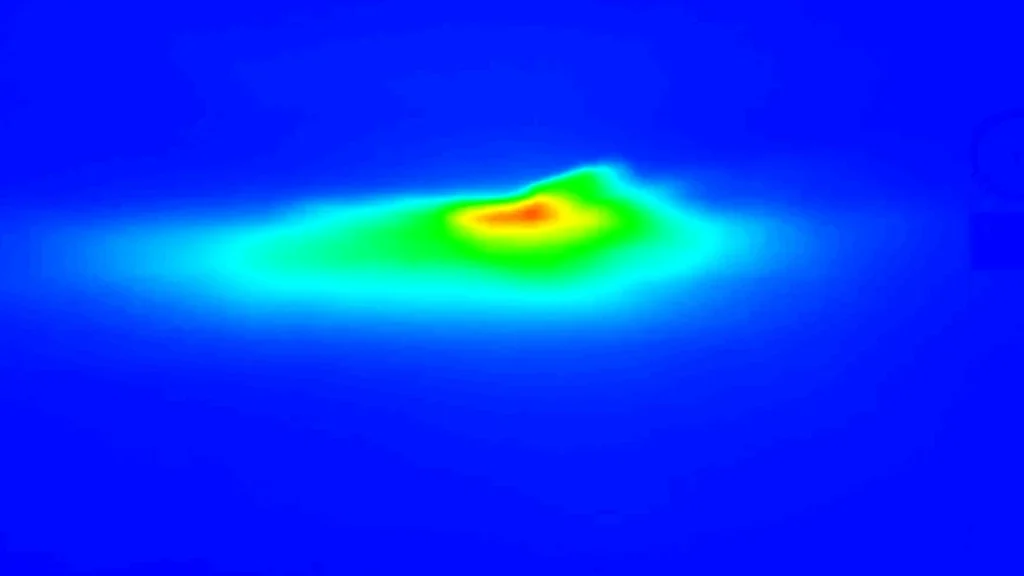
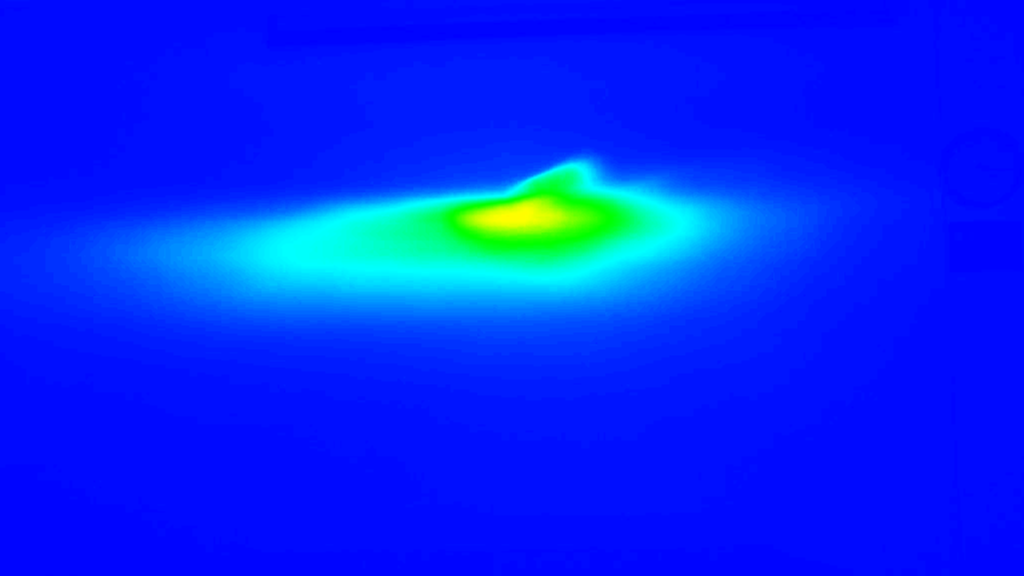
The rainbow maps show different energy distributions. EB concentrates more light into a compact red-orange hotspot, with a controlled transition into the surrounding yellow and green regions. Luxfighter produces a broader yellow-green region that extends farther upward and toward the right.
This pattern also reflects the Box-system observations. EB provides a more compact emitting structure and closer alignment with the marked Area B region, giving the headlamp optics a better-positioned source to control. Luxfighter’s higher emitting position and visible Area D illumination correspond with the upward-right spread seen in its rainbow map. Emitting thickness may contribute to this difference, although the final hotspot also depends on the LED intensity profile and the headlamp optics.
3.Nine-point illuminance with B50L focus
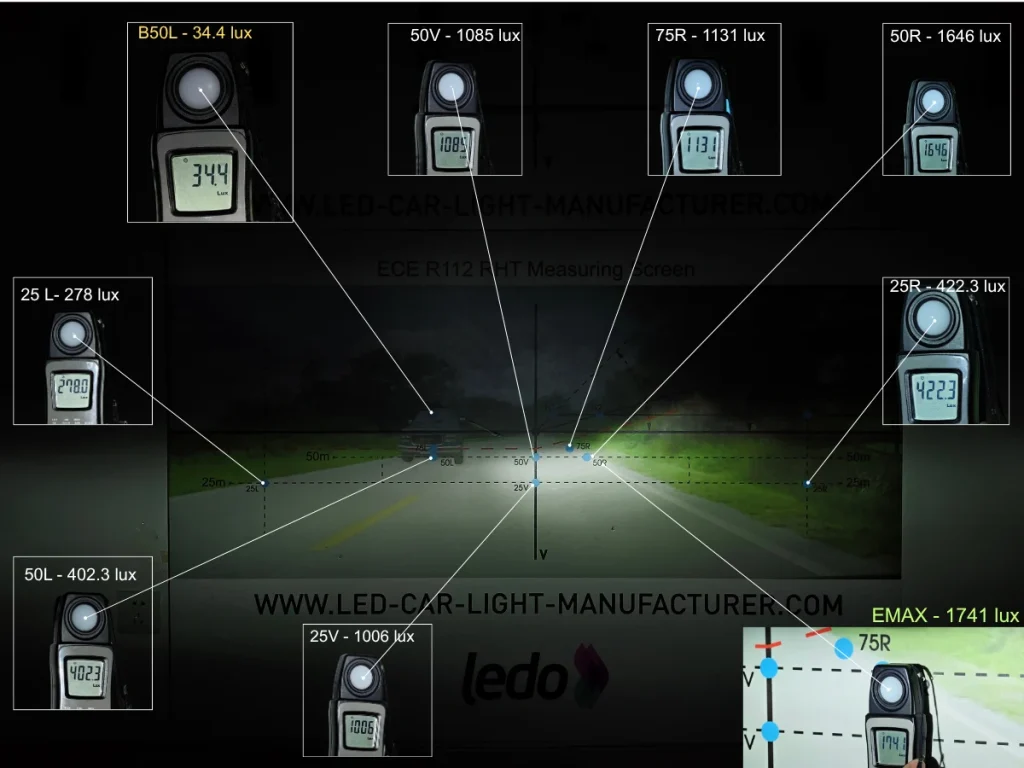
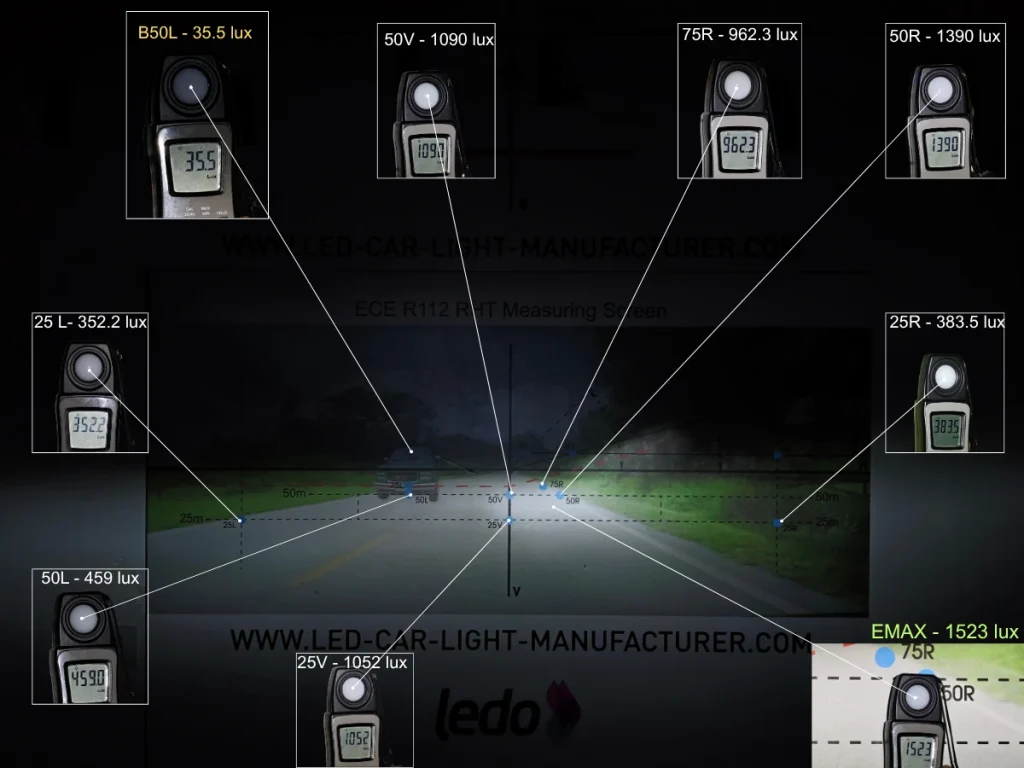
EB reaches 1,741 lux at EMAX, 218 lux above Luxfighter. At B50L, EB records 34.4 lux versus Luxfighter’s 35.5 lux. EB therefore combines a higher recorded peak with slightly less light at this specific glare-control point.
| Point or group | Measurement purpose | Interpretation |
|---|---|---|
| B50L | Glare-control point above and left of the cutoff | Lower illuminance means less light at this point. |
| 50L | Controlled left-side distribution below the cutoff | Assess against the applicable upper and lower limits. |
| 25L | Left-side illumination | Higher means more light at this point; it is not B50L. |
| 50V / 25V | Central distribution | Shows the light placed at the central reference points. |
| 75R / 50R / 25R | Right-side distribution | Shows light at the three right-side reference points. |
| EMAX | Peak illuminance | Records the highest measured illuminance. |
| Point | EB (lux) | Luxfighter (lux) | EB − Luxfighter (lux) | EB relative to Luxfighter | Comparison |
|---|---|---|---|---|---|
| B50L | 34.4 | 35.5 | −1.1 | −3.10% | EB records 1.1 lux less at the glare-control point. |
| 25L | 278 | 352.2 | −74.2 | −21.07% | Luxfighter is higher at this left-side point. |
| 50L | 402.3 | 459 | −56.7 | −12.35% | Luxfighter is higher; applicable limits govern interpretation. |
| 50V | 1,085 | 1,090 | −5 | −0.46% | The central readings differ by 5 lux. |
| 25V | 1,006 | 1,052 | −46 | −4.37% | Luxfighter is higher at this central point. |
| 75R | 1,131 | 962.3 | +168.7 | +17.53% | EB is higher at the right-side point. |
| 50R | 1,646 | 1,390 | +256 | +18.42% | EB is higher at the right-side point. |
| 25R | 422.3 | 383.5 | +38.8 | +10.12% | EB is higher at the right-side point. |
| EMAX | 1,741 | 1,523 | +218 | +14.31% | EB records the higher peak illuminance. |
EB records 14.31% higher EMAX and higher illuminance at 25R, 50R and 75R. Its B50L reading is also lower, although the gap is small at 1.1 lux: 34.4 versus 35.5 lux. Luxfighter is higher through the centre-left, with 50V nearly level at 1,090 versus 1,085 lux. EB’s measured optical advantage is higher right-side and peak output without a higher B50L reading in this setup. These 3.5 m results compare sample distribution, not type-approval compliance.
| Beam Pattern and Illuminance Comparison Summary |
|---|
| Comparison | EB observation | Luxfighter observation | Result |
|---|---|---|---|
| White-wall beam pattern | Lower hotspot with cleaner control above the cutoff. | Higher hotspot with more light around the rising section. | EB provides better control around the cutoff. |
| Rainbow map | Compact red-orange hotspot with a controlled surrounding transition. | Broader energy region extending upward and to the right. | EB concentrates more light around the intended hotspot. |
| Nine-point illuminance | Lower B50L and higher readings at 25R, 50R, 75R and EMAX. | Higher centre-left readings; 50V is nearly equal. | EB records 14.31% higher EMAX and stronger output at all three right-side points. |
The Box-system, white-wall and rainbow images consistently show EB’s more compact and better-positioned light distribution. The measurements support this result: EB combines a slightly lower B50L value with higher peak and right-side illuminance. Luxfighter provides more centre-left light, but EB offers the stronger combination of cutoff control, hotspot concentration and right-side output.
Temperature and Fan Noise
Surface temperature was recorded after 30 minutes. Fan noise was measured separately at 3.5 cm.
1.Emitting-Area Surface Temperature After 30 Minutes
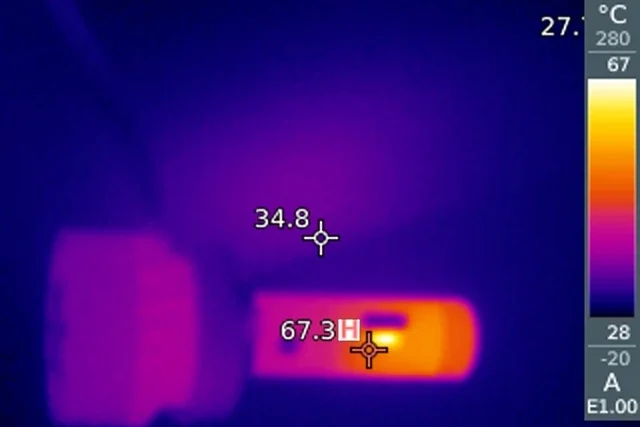
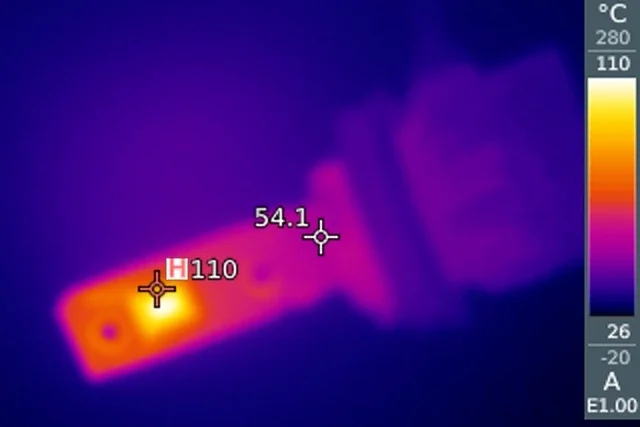
EB records 67.3°C at the LED emitting section, compared with 110°C for Luxfighter, a difference of 42.7°C. With similar surrounding temperatures, EB shows significantly lower local heat accumulation under the same test conditions.
These are surface temperatures, not LED junction temperatures.
2.Operating noise at 3.5 cm from the fan
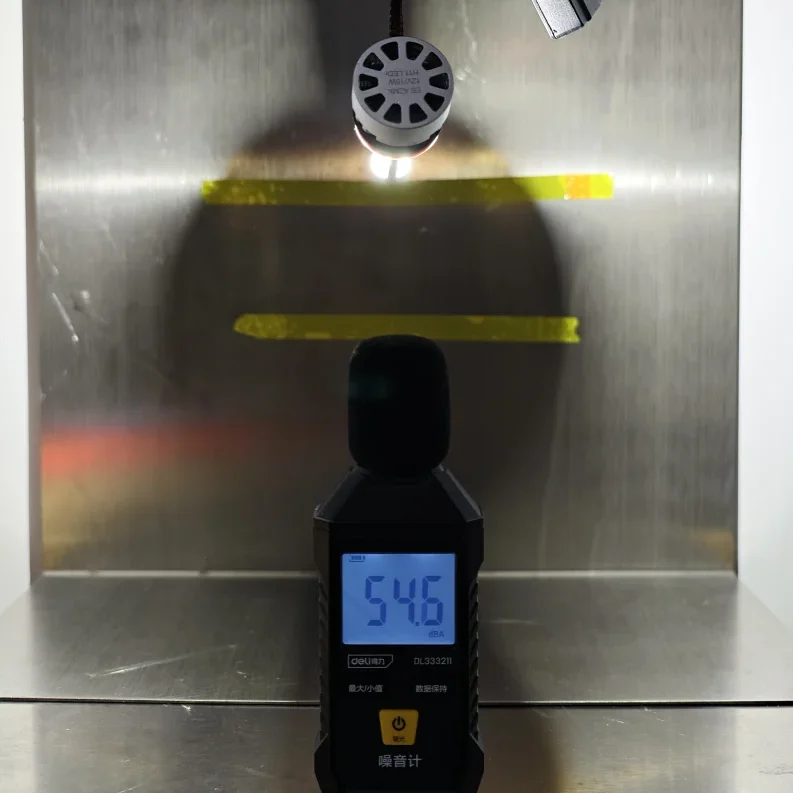
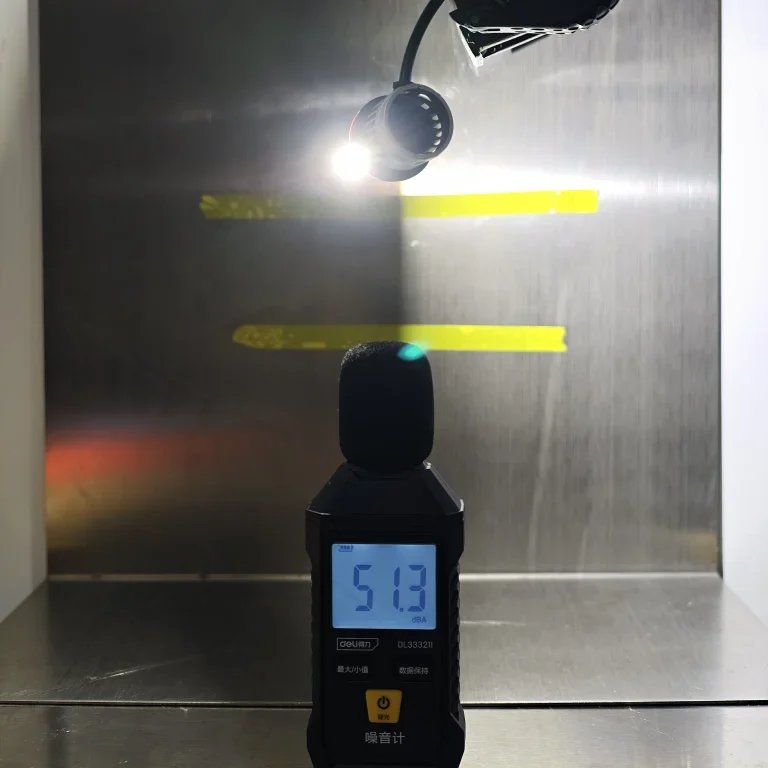
EB measures 54.6 dBA and Luxfighter 51.3 dBA. Luxfighter is 3.3 dBA lower in this close-range fan-noise test.
| Temperature and Fan-Noise Results |
|---|
| Metric | Test condition | EB | Luxfighter | Result |
|---|---|---|---|---|
| Emitting-area surface temperature | 13.2 V, 26°C, after 30 minutes | 67.3°C | 110°C | EB is 42.7°C lower. |
| Fan noise | 3.5 cm from the cooling fan | 54.6 dBA | 51.3 dBA | Luxfighter is 3.3 dBA lower. |
After 30 minutes, EB’s emitting-area surface is 42.7°C cooler. Luxfighter records 3.3 dBA less fan noise at 3.5 cm.
What This Comparison Means for Customers
- Packaging: EB uses 19.90% less box volume and includes a hanging feature for peg-hook display. Luxfighter’s empty package is 7 g lighter but has no hanging tab or Euro-slot.
- Construction: EB includes a separate metal retaining spring; no equivalent spring is visible on the tested Luxfighter sample.
- Emitting geometry: EB’s 1.154 mm opposing-surface distance is 53.24% thinner than Luxfighter’s. Its emitting band also aligns more closely with B1–B3 and keeps Area D dark.
- Light distribution: EB records 14.31% higher EMAX, stronger readings at 25R, 50R and 75R, and a slightly lower B50L value. Luxfighter places more light through the centre-left field.
- Temperature and noise: EB’s emitting surface is 42.7°C cooler after 30 minutes, while Luxfighter’s fan is 3.3 dBA quieter.
Overall conclusion: EB delivers the stronger combination of retail-ready packaging, secure spring retention, compact emitting geometry, controlled light distribution, right-side output and thermal performance. Luxfighter offers a lighter empty package and quieter fan, but EB provides more practical advantages across the complete comparison.
EB vs Luxfighter H11 LEDr FAQ
Author: Jack Liu, Co-founder & Product Director, LEDOAUTO
Regulatory check: LEDOAUTO Engineering Team, verified against official UNECE documents
Last updated: September 3 2026
Update note: rewrote the comparison around reader-first explanations and section-specific insights while preserving the original measurements.
The category terminology used in this comparison follows the UNECE light-source category resolutions. Additional context is available in the ECE R37 H11 LEDr background.
References
luxfighter H11 LEDr Review: Construction, Beam Pattern, Illuminance, Temperature and Noise