
If you are comparing ECE R37 vs R128 vs R99, you are usually trying to answer one practical question: which UN Regulation covers the LED product in front of you? The division of labor is straightforward once you separate products by technology and by use case. UN R37 (ECE R37) covers standardized filament light sources and their approved LED replacement light sources, known as LEDr, for use in approved lamps and as replacements in vehicles already on the road. UN R128 covers LED light sources approved for new lamp designs. UN R99 covers gas-discharge light sources, the technology behind HID lamps. All three sit inside the UNECE framework of the 1958 Agreement, not inside EU legislation.
Which regulation applies to which product?
A short answer for procurement files:
- A replacement LED bulb that carries the category name of a filament light source, for example an H11 LEDr, belongs under UN R37.
- An LED light source supplied for a new lamp design, approved as part of that lamp’s homologation, belongs under UN R128.
- An HID gas-discharge light source belongs under UN R99.
All three approvals result in an E-mark, so the mark alone does not tell you which regulation applies. The number after the “E” identifies the approval authority that granted the approval. It does not identify the country of manufacture, and it does not tell you the product category. The category name on the product and the approval document behind it carry that information. Electromagnetic compatibility under UN R10 is a separate requirement and never replaces light-source category approval.
Three regulations, three product worlds?
UN R37: filament light sources and LEDr replacements
UN R37 approves standardized filament light sources and, following the LEDr amendments, their LED replacement counterparts. The text verified for this page is UN Regulation No. 37, Revision 7, Amendment 11, checked against the official UNECE document set on 15 July 2026. An LEDr category carries the same name as the filament category it replaces. That naming is what allows the LED product to serve as a like-for-like replacement in an approved lamp, or as a service part in a vehicle already in use. The approval attaches to the light source type. It does not by itself decide where the product may be used on the road, and it does not transfer to other categories, other lamps, or other markets.
UN R128: LED light sources for new applications
UN R128 approves LED light sources as a technology of their own. Within the UNECE framework, LED substitutes under R128 are intended for new applications: the lamp that uses such a light source must include it in the lamp approval under the relevant lamp regulation, such as UN Regulation No. 149 for road illumination devices. When LEDr was brought into UN R37, the formal proposal to WP.29/GRE (ECE/TRANS/WP.29/GRE/2020/15/Rev.1) explicitly excluded continued approval of LEDr under R128. For a buyer, that boundary has a direct consequence. An “R128-approved LED bulb” claim for a filament replacement scenario does not follow the current regulatory design, no matter how professional the document looks. The correct question back to the supplier is which regulation and which category the approval actually covers.
UN R99: gas-discharge light sources, with an evidence boundary
UN R99 is the UN Regulation for gas-discharge light sources. One boundary applies here and we state it plainly. The official UNECE document set verified for this page, checked on 15 July 2026 and re-checked on 24 July 2026, does not include the current consolidated R99 scope text. We therefore state only what the verified sources support: R99 is the gas-discharge light source regulation. This page does not extend R99 to specific replacement scenarios, because the verified sources do not. If an HID product is part of your sourcing decision, request the R99 approval documentation from the supplier and have it checked against the current consolidated text before you rely on it.
How do ECE R37, UN R128 and UN R99 compare side by side?
Each row states only what the verified documents support. Where verification stops, the table says so.
|
Dimension |
UN R37 (ECE R37) |
UN R128 |
UN R99 |
|---|---|---|---|
|
Covered object |
Standardized filament light sources and their LEDr replacement light sources |
LED light sources |
Gas-discharge light sources |
|
Replaceability |
LEDr approved as replacement for the corresponding filament category, for approved lamps and vehicles in use |
LED substitutes intended for new applications; the lamp approval must include the light source |
Replacement scenarios not established in the sources verified for this page |
|
E-mark |
Approval under R37 carries an E-mark; LEDr shares the filament category name |
Approval under R128 carries an E-mark; light source sits inside a lamp approval context |
Approval under R99 carries an E-mark |
|
Typical product |
Category-named LED replacement bulbs, such as an H11 LEDr |
LED light sources built into a new headlamp or signal lamp design |
HID gas-discharge light sources |
|
Buyer scenario |
Sourcing a compliant LED replacement for vehicles already in use |
Developing or buying a new lamp with an LED light source |
Sourcing HID light sources |
|
Common misuse |
An R128 or R10 mark presented as proof of filament-replacement approval |
An R128 approval cited for a replacement bulb that belongs under R37 |
R99 cited in LED product claims |
|
Related regulations |
UN R10 (EMC) is separate; lamp-level rules such as UN R149 apply to the lamp |
Same: R10 separate; the lamp approval under R149 includes the LED light source |
Same: R10 separate; lamp level under R149 |
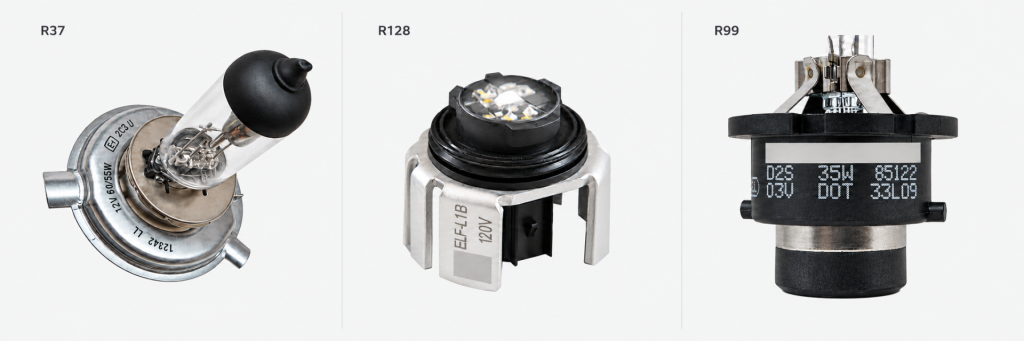
Read the table column by column rather than as one combined statement: the R37 and R128 items are effective requirements verified on 15 July 2026, while the R99 replacement entries remain an open evidence boundary.
Where do buyers get confused about which regulation applies?
“LED means R128.” Many buyers see the letters LED and assume R128 is the LED regulation, so any LED bulb should be approved there. For filament replacement scenarios the current design says otherwise: the proposal that introduced LEDr into R37 excluded the R128 path for LEDr. A bulb that replaces an H11 filament lamp in an approved headlamp sits under R37. The evidence to request is the R37 approval for that category, not an R128 certificate with a similar-looking part number.
“An E-mark means it fits my vehicle.” An E-mark shows that a type approval exists under some UN Regulation. It does not say which regulation, which category, or which lamp approval conditions apply, and it says nothing about how the destination market enforces road use. Keep three layers separate in your review: the type approval fact stated in the approval document, the design fit of the product in your lamp, and the road use conclusion in your market. A single marking cannot answer all three.
“R10 approval means road approval.” UN R10 covers electromagnetic compatibility, and the verified text is UN Regulation No. 10, Revision 6. A product can carry R10 approval and hold no light-source category approval at all. R10 evidence never proves that a product is an R37 LEDr, and it never proves road use legality on its own. File it as EMC evidence and nothing more.
Which one applies to your product?
Work through three questions.
Are you replacing a filament bulb in an approved lamp, or fitting a replacement to a vehicle already in use? Then the light source sits under UN R37. Check that the LED product carries the LEDr category name of the filament light source it replaces, and request the R37 approval for that exact category. A category name on a datasheet without the matching approval document is a claim, not evidence.
Are you developing or sourcing a new lamp with an LED light source built in? Then the light source sits under UN R128, and the lamp approval, for example under UN R149 for road illumination, must include it. Ask which lamp approval references the light source, not only whether the light source itself was tested.
Are you dealing with HID gas-discharge light sources? Then UN R99 applies, subject to the evidence boundary stated above.
Whichever branch you land on, UN R10 electromagnetic compatibility evidence is an additional requirement, not an alternative to category approval. If a supplier answers a category question with R10 paperwork, treat the category question as unanswered.
What should buyers check before placing an order?
This page is the supporting view. The complete explanation of the R37 approval framework and the sourcing process around it sits in our complete guide to ECE R37 LEDr regulation, approval and B2B sourcing. For the product-term comparison behind most supplier claims, read LEDr compliance difference: LEDr vs retrofit vs substitute. If your immediate need is a purchasable category with approval documents available for review, see the ECE R37 certified H11 LEDr product page.
Before any order, OEM, wholesale and private label buyers alike should work from the same short list. Request the approval document for the exact category. Confirm the lamp context the approval assumes. Keep R10 evidence filed separately from category approval. Record the approval status and regulatory basis of each claim with its verification date, so the file still makes sense at the next annual review. A downloadable pre-purchase checklist is being prepared; until it is live, ask our engineering team for the current verification list with your inquiry.
Frequently asked questions
Author: Jack Liu — Co-founder & Product Director, LEDOAUTO
Regulatory review: LEDOAUTO Engineering Team — verified against official UNECE documents
Last reviewed: 24 July 2026