H11 LEDr approval means that a specific LED replacement light-source type has been approved under UN Regulation No. 37 against the H11 LEDr category requirements. It does not make every H11-shaped LED bulb legal. For a European importer, the useful question is whether the offered type, its physical markings, its approval document, the receiving lamp category, and the intended market all match.
Is H11 LEDr approved under UN R37?
Yes. H11 LEDr is an effective category within the UNECE light-source framework. The current basis combines UN Regulation No. 37, Revision 7, Amendment 11 with the applicable H11 LEDr category sheets in R.E.5. The 2024 amendment introduced Configuration 2 for H11 LEDr, with that R.E.5 version valid from 13 November 2024, as recorded in ECE/TRANS/WP.29/2024/156.
This is a category and type-approval statement. It is not an unconditional road-use statement. R.E.5 limits an LEDr category to lamps approved with a filament light source of the same category designation. An approved H11 LEDr therefore belongs in a lamp approved for H11, subject to the approved type, correct installation, and the rules applied in the destination market.
A generic H11 LED retrofit does not gain this status because it fits a PGJ19-2 socket or carries an E-mark. The approval must relate to the actual product type. The number and category on the product must agree with the approval document.
Why did H11 become the first practical LEDr category?
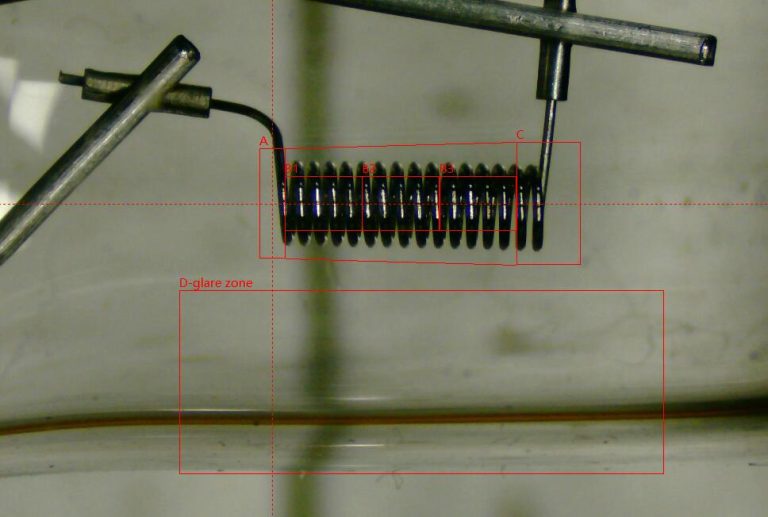
UNECE documents do not give one official sentence naming H11 as the easiest or best category. The engineering record supports a narrower inference. H11 is a single-function category with a standardized PGJ19-2 cap and a defined relationship between the reference plane and the light-emitting region. Those features give engineers measurable geometry for comparing an LED source with the H11 filament source it replaces.
The historical H11 LEDr category-sheet proposal shows how the cap, envelope, emitting region, electrical conditions, and photometric checks were specified. It is a proposal document used to explain the development history, not a substitute for the current consolidated requirements.
An informal H11 equivalence report from 2020, reviewed by the LEDOAUTO Engineering Team on 15 July 2026, also records the technical comparison work. Its informal status matters. It explains the reasoning behind equivalence checks but does not, by itself, prove that a current product type is approved.
For an importer, H11’s history is less important than the evidence chain. A supplier should be able to connect the physical lamp marking to an approval issued for the same type and category. Product design similarity alone is not enough.
What is tested for H11 LEDr approval?
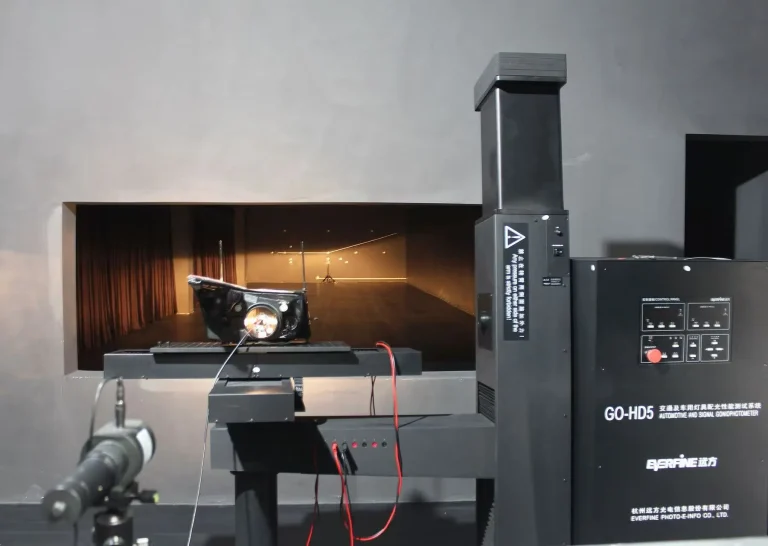
UN R37 approval is not a lumen-only test. The applicable requirements assess whether the light source matches its category definition and performs under controlled geometric, photometric, electrical, thermal, and marking conditions.
The approval evidence should cover the cap and interchangeability dimensions, the maximum outline, the position and size of the light-emitting region, luminous flux and light distribution, light color, electrical characteristics, thermal behavior and performance after warm-up, polarity and modulation behavior where applicable, defined failure behavior, and required product and packaging markings.
Geometry matters because a reflector or projector approved around an H11 filament expects light from a defined position and region. A bulb can fit the socket while placing its emitters too far forward, too far back, or outside the intended area. Physical fit and approved optical performance are different claims.
The same distinction applies to UN R10. R10 covers applicable electromagnetic compatibility requirements. It does not establish H11 LEDr approval under UN R37 and cannot prove road use by itself.
Exact numerical limits are not reproduced here. Buyers who need them should review the current category sheets and request the approved technical documentation for the offered type. Historical proposal values should not be copied into a purchase specification without checking the current approval basis.
What is the status of H8, H16, and HB4 LEDr?
H8 and H16 are related to H11 through the PGJ19 cap family, but they are separate categories. An H11 LEDr approval does not cover H8, H16, or HB4.
|
Category |
Current Status |
Effective date |
Source |
|---|---|---|---|
|
H11 LEDr |
Effective, verified 17 July 2026 |
13 November 2024 |
ECE/TRANS/WP.29/2024/156 (Configuration 2 amendment) |
|
H8 LEDr |
Effective, verified 17 July 2026 |
11 March 2026 |
R.E.5 Amendment 12 (ECE/TRANS/WP.29/2026/41) |
|
H16 LEDr |
Effective, verified 17 July 2026 |
11 March 2026 |
R.E.5 Amendment 12 (ECE/TRANS/WP.29/2026/41) |
|
HB4 LEDr |
Effective, verified 17 July 2026 |
11 March 2026 |
R.E.5 Amendment 12 (ECE/TRANS/WP.29/2026/41) |
ECE/TRANS/WP.29/2026/41 contains the Amendment 12 category changes. Each product still requires approval for its own category and type.
H4 and H7 vehicle-based positive-list approvals used in some countries follow a different mechanism. They must not be described as effective UN R37 H4 LEDr or H7 LEDr category approvals.
Where can an H11 LEDr be used on the road in Europe?
UN R37 belongs to the UNECE 1958 Agreement framework. It is not an EU-only regulation, so “EU certification” is not an accurate substitute for UN type approval.
Road use depends on several conditions: the light source must be the approved H11 LEDr type, its markings must match the approval documents, it must be installed in a lamp approved for an H11 filament light source, installation must follow the applicable approval conditions, and destination-market registration, inspection, and enforcement rules must be checked.
A product page cannot clear every H11 vehicle application. Light source approval does not certify every vehicle, every lamp, or every installation. Importers should identify their target markets and confirm whether national documentation, labeling, or inspection evidence is required.
For the United States, the product should be marketed for off-road use only. Physical fit in an H11 socket does not establish US road compliance.
What does H11 LEDr approval not prove?
H11 LEDr approval does not prove that every H11 LED bulb is approved. It cannot be transferred from one holder, product type, or category to another. It does not cover H8, H16, H4, H7, or another light source category.
An E-mark alone is also insufficient. The country identifier shows which authority granted an approval. It is not a country-of-origin mark and does not, by itself, show which regulation, category, or product type the approval covers.
A standardized PGJ19-2 cap supports physical fit. It does not replace the approval document or prove correct optical performance. CE, RoHS, R10, socket compatibility, and UN R37 approval are separate evidence claims. Supplier files and sales copy should keep them separate.
How can buyers verify an H11 LEDr approval number?
Start with the physical product rather than the supplier’s headline.
Photograph the marking on the light source and record:
- the E-mark and approval number;
- the H11 LEDr category designation;
- the product type;
- the brand or approval holder;
- the rated voltage and other required identifiers;
- the corresponding information on the packaging.
Request the complete approval document and compare those fields. Check the approval holder, manufacturer, brand relationship, extensions, and any conditions. A certificate for another product, category, or company does not validate the sample.
Then confirm the intended use. The receiving lamp must be approved for H11, and the buyer should document the target countries. Keep the approval document, product photographs, purchase specification, and change-control record in the supplier file.
If the supplier changes the driver, emitter arrangement, cap, housing, rated voltage, thermal design, or product type, request written confirmation that the approved configuration still applies.
What should buyers request for an AZMK EB H11 LEDr inquiry?
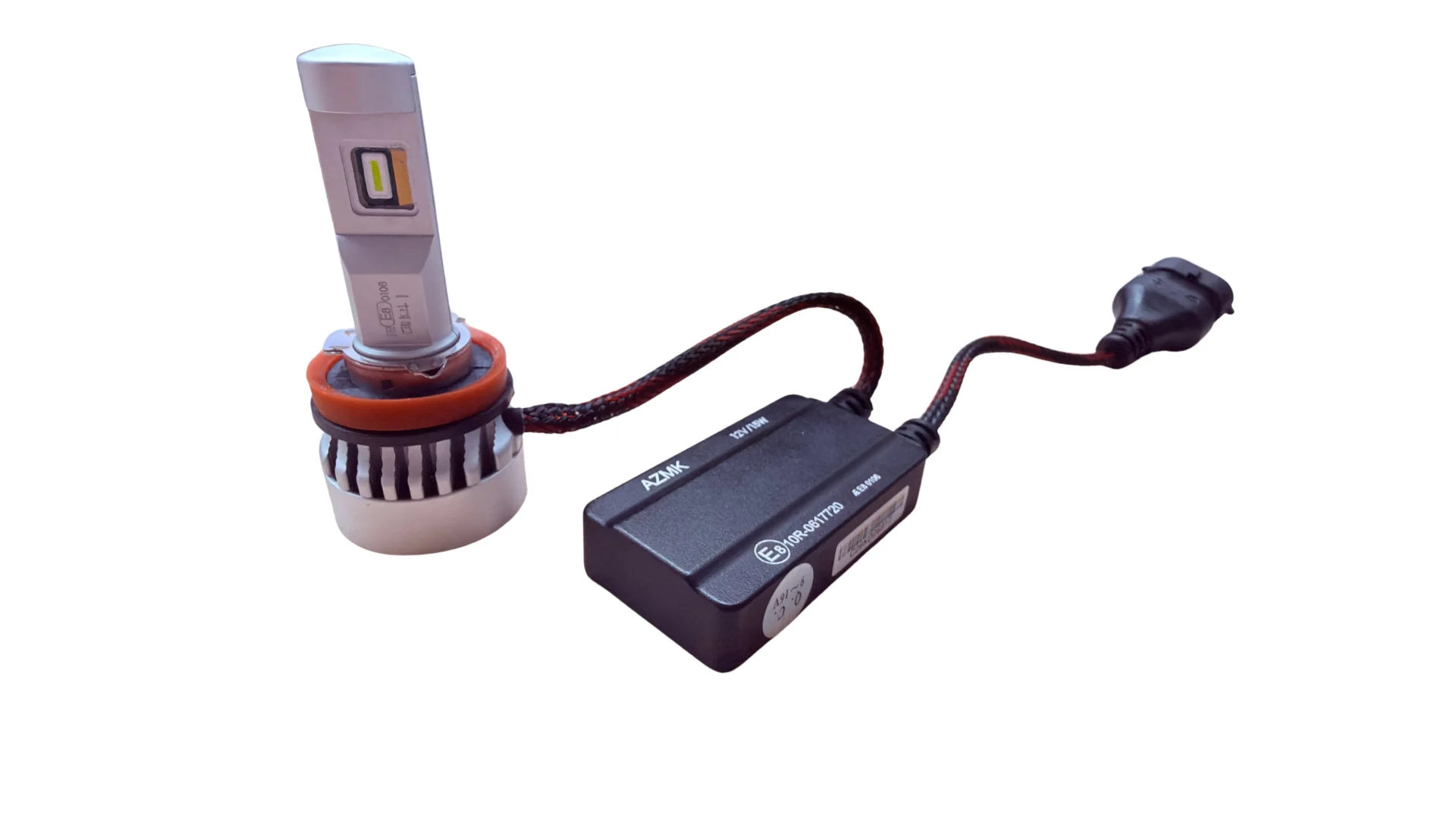
AZMK identifies the brand used for the EB H11 LEDr product line. The brand name is an entity identifier, not an approval claim, and it does not extend the regulatory status of any product type.
For an AZMK EB H11 LEDr wholesale inquiry, send the destination markets, annual volume, packaging requirements, and the intended H11 applications. Ask LEDOAUTO for the approval evidence that matches the offered product type, controlled product specifications, marking photographs, and the applicable change record.
The ECE R37 H11 LEDr product page is the planned product-level next step. Buyers comparing regulatory mechanisms can continue to the LEDr compliance guide and the LEDr versus retrofit versus substitute comparison. All three targets require CMS status confirmation before this page goes live.
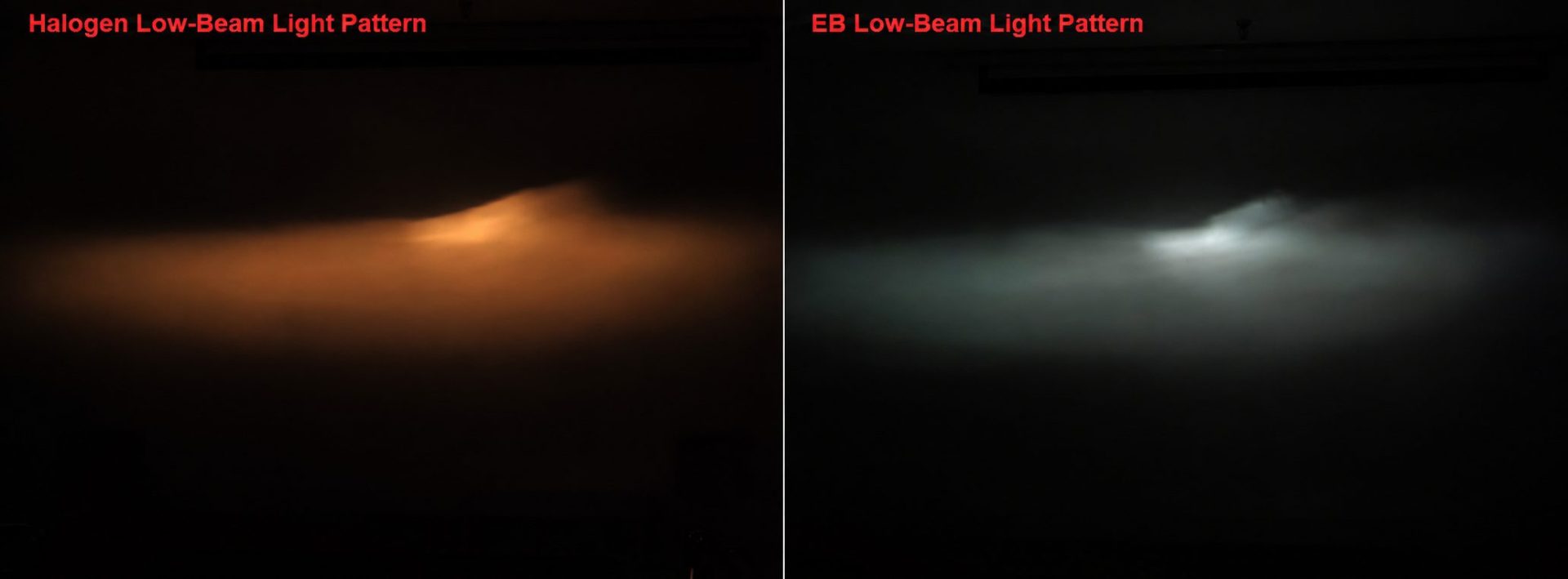
Halogen Low-Beam Light Pattern vs. EB H11 Low-Beam Light Pattern
Frequently asked questions
By Jack Liu, Co-founder & Product Director, LEDOAUTO
Regulatory review: LEDOAUTO Engineering Team, verified against official UNECE documents
Last reviewed: 17 July 2026