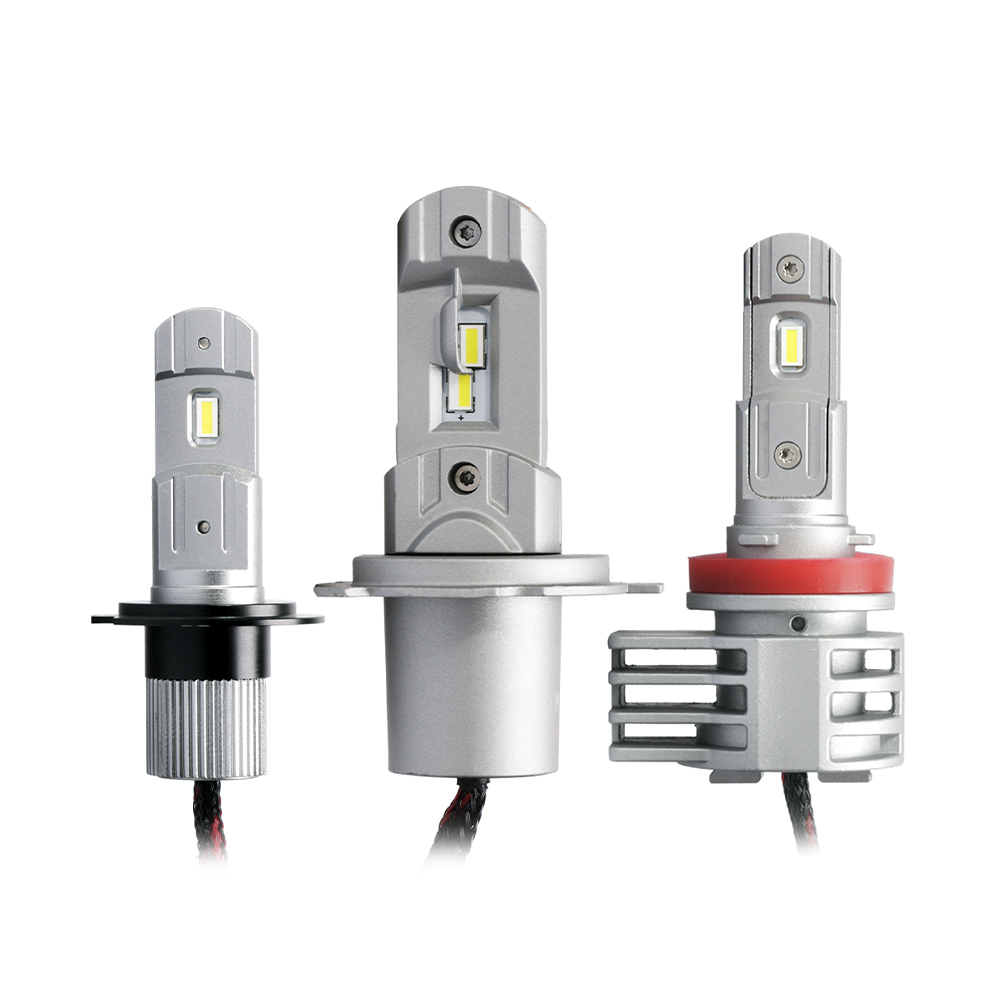

ECE R37 Certified H11 LEDr Bulb Manufacturer for OEM and Wholesale
- UN R37 type approval. The EB is approved as an H11 LEDr light source, not a generic retrofit carrying an unrelated E-mark.
- Fits by design. Built to the standardized H11 interface and category envelope, so the default type needs no per-vehicle compatibility list.
- OEM and private label support. Brand and packaging work within the boundaries the approval process allows, with documents that match.
UN R37 type approval.
The EB is approved as an H11 LEDr light source, not a generic retrofit carrying an unrelated E-mark.
Fits by design.
Built to the standardized H11 interface and category envelope, so the default type needs no per-vehicle compatibility list.
OEM and private label support.
Brand and packaging work within the boundaries the approval process allows, with documents that match.
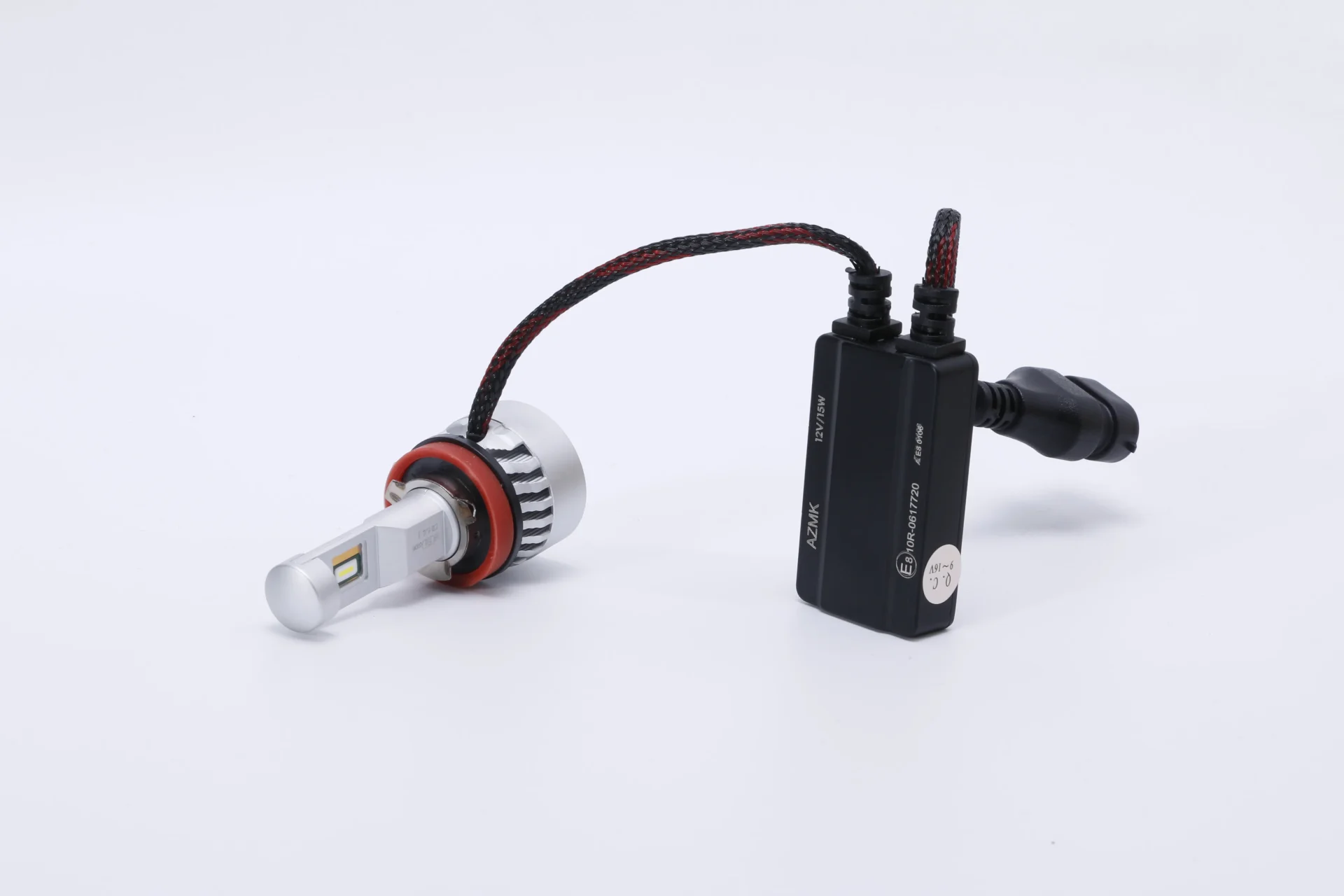
What is approved for this product?
UN R37 type approval applies to a defined light-source type and category. It does not automatically extend to every bulb a factory sells, every brand name, or every later product change. For the EB, the approval covers the H11 LEDr type, and the certificate, approval code and category designation correspond to the durable marking on the bulb body.
The country number beside the E-mark identifies the authority that granted the approval. It is not a country-of-origin mark, and on its own it does not prove road legality.
The current UN R37 consolidated text is the regulatory basis behind the approval.
|
Category |
Status |
Effective |
Source |
|---|---|---|---|
|
H11 LEDr |
Effective (established H11 LEDr category under UN R37) |
Established in the current UN R37 consolidated text |
UN R37, Rev.7, Am.11 (rechecked 3 August 2026) |
|
H4 / H7 |
Not a UN R37 LEDr category. Some national positive-list acceptance exists for whole-vehicle use. |
n/a |
Project regulatory rules; national mechanism is not UN R37 approval |
H11 status applies within the category, approval and market conditions the official documents support. H4 and H7 products accepted through a national vehicle list follow a different route, and that national mechanism is not the same as UN R37 LEDr category approval. The full category landscape, including categories still in development, is covered on our approved LEDr categories overview.
Road use is narrower than physical fit and still depends on the approval conditions and the destination market’s rules. ECE R37 is part of the UNECE framework, not an EU-only regulation. In the United States, this product is for off-road use only.
Which specifications can buyers verify?
The EB is built to the H11 LEDr category requirements, and our production testing checks each unit against them. The values below describe our production samples; the “verify against” column shows what a buyer’s compliance team should match them to.
|
Parameter |
EB |
|---|---|
|
Base and interface |
PGJ19-2;standardized H11 interface; |
|
Rated voltage and operating range |
12 V system; Test voltages: 12 V, 13.2 V and 14 V Five samples were tested. |
|
Luminous flux (stabilized) |
At 1 min: 1,419–1,468 lm At 30 min:1,382–1,457 lm Five-sample average at 13.2 V:1,454 lm at 1 min1,409 lm at 30 min |
|
Colour and chromaticity |
Colour: White |
|
Power and current |
average at 13.2 V:14.59 W at 1 min;14.50 W at 30 min Current at 12 V: 1,176–1,303 mA at 1 min;1,173–1,298 mA at 30 min Current at 14 V: 987–1,103 mA at 1 min;983–1,097 mA at 30 min |
|
Thermal result |
Cap-temperature limit:120°C maximum Five-sample average:40°C at 1 min; 46.2°C at 30 min. |
|
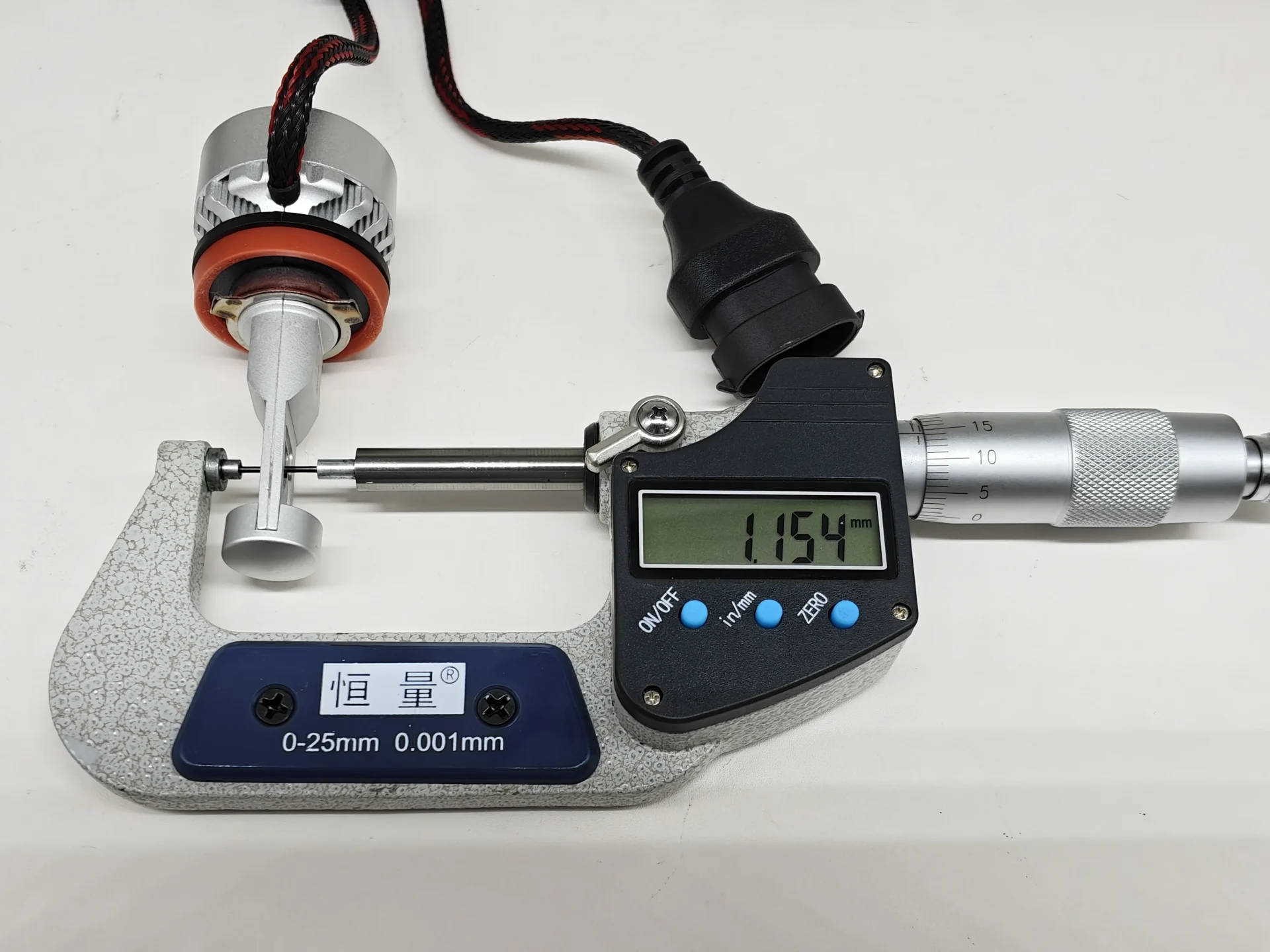
Emitter position |
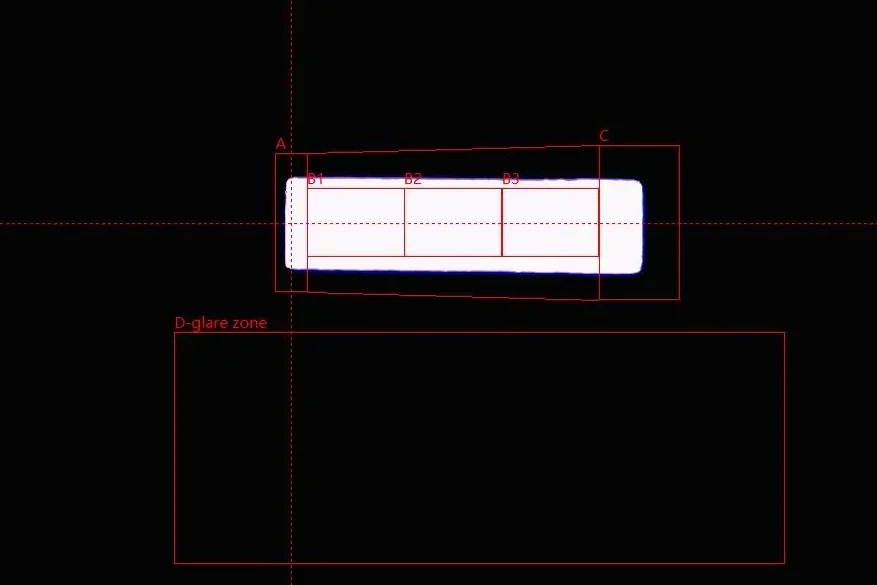 |
Measured production data supports sample evaluation and quality control. It sits alongside the type-approval test reports rather than replacing them, and both are in the document pack.
What evidence comes with an order?
The document pack is built so the product-to-document match is easy to audit.
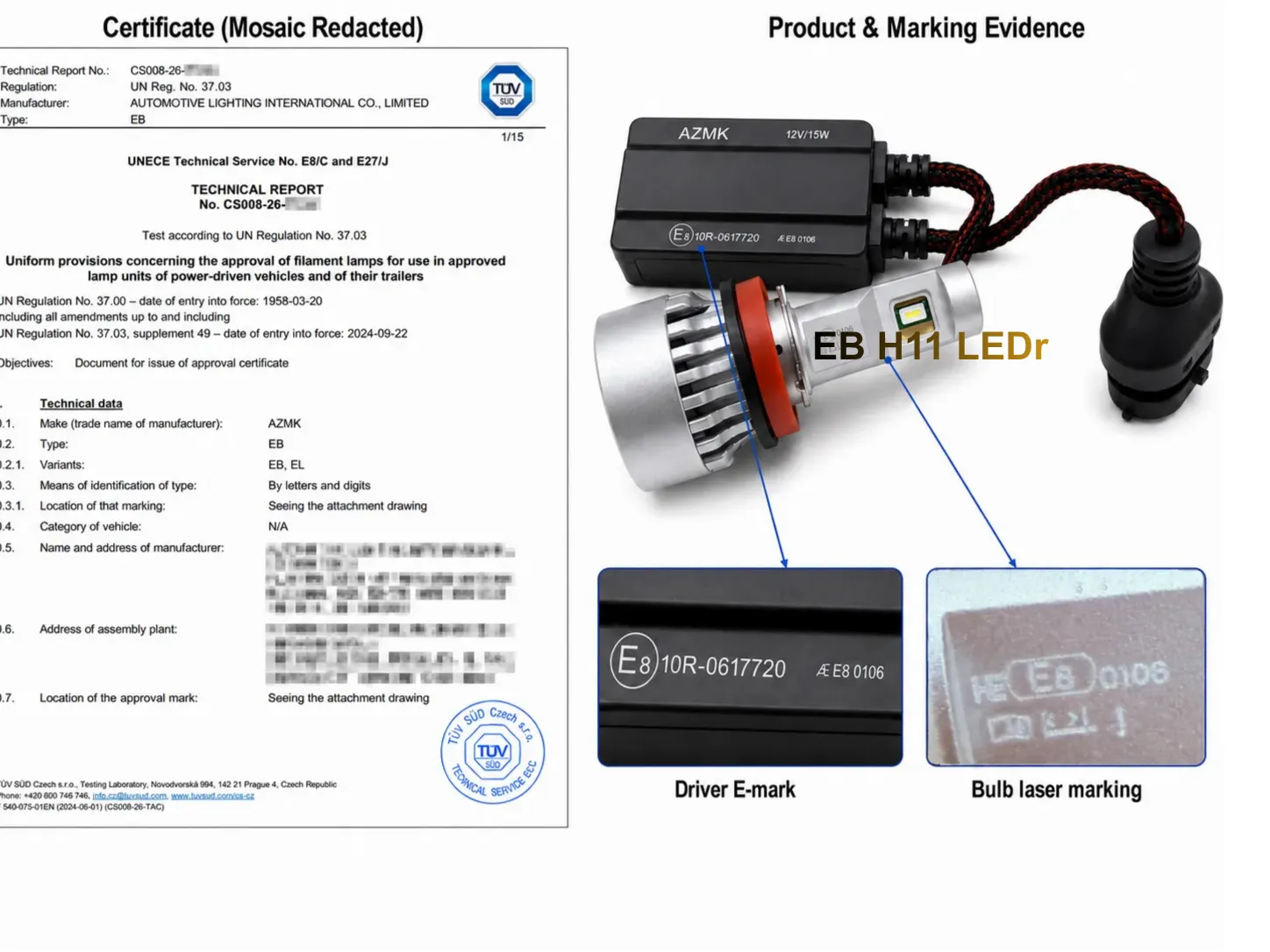
It starts with a redacted type-approval communication showing the certificate holder, the approved type, the regulation, the H11 LEDr category and the approval code. A separate annotated product photo points to the corresponding marking on the bulb. Redaction hides sensitive address detail and part of a reference number, while leaving enough for your team to confirm what matches. For a step-by-step walkthrough, see how to verify an ECE R37 H11 LEDr certificate.
Optical, electrical, geometry and thermal reports identify their samples and conditions, and production data uses the same identity as the certificate and approved type.
Conformity of Production is ongoing. Before approval, the authority verifies that the manufacturer has arrangements to control production conformity, and approved products must keep meeting the marking and technical requirements. UN R37 does not set one universal per-batch or monthly schedule for every company, so our CoP statement describes the batch controls and records we actually keep. An approval can be withdrawn if production stops conforming to the approved type, which is why experienced buyers ask for this document, not only the certificate.
R10 evidence has a separate job. It covers electromagnetic compatibility, and it does not replace the optical, geometric, thermal or category requirements of UN R37. A bulb carrying only an R10 marking is not an H11 LEDr. For the EB, R10 evidence sits with the R37 approval, not in place of it.
What should a buyer request before ordering?
Ask for the certificate index, the redacted approval communication, the annotated marking photo, the test-report index and the CoP summary before approving a bulk order, and check that the names and identifiers agree across the pack. If a supplier offers only an E-mark image, ask for the document that connects that marking to the offered type.
Order samples in the proposed production specification and record your bench and installation observations for the target market. Sample testing confirms what you are buying; it does not widen the approval scope.
How does fit by design affect vehicle checks?
The EB is designed around the standardized H11 interface, including the PGJ19-2 base and the category geometry. That is a structural difference from a generic retrofit, which often depends on a long vehicle list because its body or emitter location does not follow the category envelope. Fit by design is not an unconditional compatibility promise, and it does not turn physical installation into a road-use claim. Practical checks such as dust-cap clearance or the vehicle’s bulb-outage detection still belong in your sample testing. The full explanation, with envelope measurements, is on our page on why an ECE R37 H11 LEDr fits by design.
How do OEM and wholesale orders work?
Private label is not a certificate-loan arrangement. Where only the trademark changes and the same manufacturer produces a fully identical product, UN R37 provides a defined path under §2.2.3: a manufacturer’s declaration of identity plus samples carrying the new mark. The approval authority recognizes that route before the branded product is presented as approved.
Packaging artwork and brand presentation are the usual customization. The approval marking, category, rated voltage, LEDr marking, applicant identity and any restricted-use information stay fixed. A change that affects optical output, base or emitter geometry, electronic characteristics, ratings, thermal performance or the identification of the approved type needs an extension or a new approval assessment. Packaging must still carry the trademark, rated voltage, category designation with LEDr, and the approval code.
The order flow is inquiry, document review, sample evaluation, private-label scoping and production. Give us the target market and forecast so the quotation separates standard packaging from custom work.
- Inquiry:target market, annual volume, private-label requirement.
- Documents:review the redacted certificate, test reports and CoP statement.
- Samples:bench and vehicle testing on your priority models.
- Order:confirm artwork and any private-label scoping, then place the bulk order; CoP batch testing applies to every run.
|
Standard Packaging MOQ |
The minimum order quantity for boxes is typically 2,000; 1,000 for standard boxes and 500 for deluxe boxes |
|---|---|
|
Custom Packaging |
Packaging can be customized within the boundaries the approval process allows |
|
Sam and leadtime |
EB usually has items in stock and can ship within 2–3 days |
|
Delivery Dates |
About 25 days |
|
Warranty Period |
Within 3 years |
|
RMA Terms and Conditions |
For the warranty, please provide the required photos and videos, and restock with the next order |
Frequently asked questions
References
EB H11 LEDr Review: Construction, Beam Pattern, Illuminance, Temperature and Noise